

Mixed Container FMCG from Vietnam: How Consolidated Orders Work
A mixed container FMCG Vietnam order combines multiple approved products or brands in one planned container shipment. For an importer or distributor, that can create a broader assortment than a single-SKU order. It also creates more coordination work: every SKU, case quantity, carton measurement, date condition, label requirement and document description must fit one confirmed plan. “Mixed” describes the assortment inside the container. It does not mean LCL, unrestricted quantities or automatic acceptance of every product combination. This guide explains how a consolidated order moves from the buyer brief to final document reconciliation, and what information should be confirmed before loading.
Key takeaways
- Start with the destination, product shortlist, target quantities and delivery window—not a container-size assumption alone.
- Treat pack, carton, weight, volume, date-code and label data as order-specific until verified.
- Approve substitutions and quantity changes in writing before they flow into loading and documents.
- State the Incoterms® rule, named place and version, then document payment terms separately.
- Release the loading plan only after the SKU readiness matrix and document source data agree.
What Is a Mixed FMCG Container?
A mixed container is a full container order built from more than one confirmed product line. The assortment may include different SKUs, pack sizes, brands or compatible categories, subject to sourcing, handling, label, document and loading feasibility. Products are consolidated into one controlled shipment rather than treated as unrelated orders.
The term is easy to misunderstand. A mixed container is not automatically a less-than-container-load service, and it does not mean that a buyer can select any quantity of any item. OneDayFMCG's standard MOQ is one mixed container. There is no separate fixed minimum per SKU, carton or pallet, provided the confirmed assortment can complete the container. The actual SKU and case quantities still need to be checked against pack configuration, sourcing conditions and the final load plan.
Buyers can browse the FMCG catalogue to build an initial shortlist. Catalogue information supports discovery; current packs, quantities and availability must be confirmed for the specific order.
When Consolidation Can Fit a Distributor
A mixed assortment can fit a distributor serving several retail channels, regions or customer profiles. It may allow the order to combine core lines with a smaller number of discovery lines, or to spread the planned volume across several compatible categories. This is a commercial planning choice, not a guarantee that every combination will improve cost or sell-through.
Efficiency depends on the actual quantities, case increments, origin points, handling steps, load utilization and agreed freight terms. A broader assortment can also increase the number of approvals and possible exception points. Buyers should compare the value of range breadth with the effort needed to manage more product records, labels and document lines.
Compatibility matters as much as commercial interest. Heavy cartons can crush lighter cases. Leaking liquids can damage dry goods. Heat, odor, hygiene or regulatory requirements can separate products that appear suitable in a catalogue. The final combination should therefore be reviewed against product-specific evidence and the shipment route.
The Seven-Stage Mixed-Order Workflow
The following workflow is a planning framework, not a fixed lead-time promise. Stages may overlap or require additional checks depending on the products, manufacturers, destination and contractual scope.
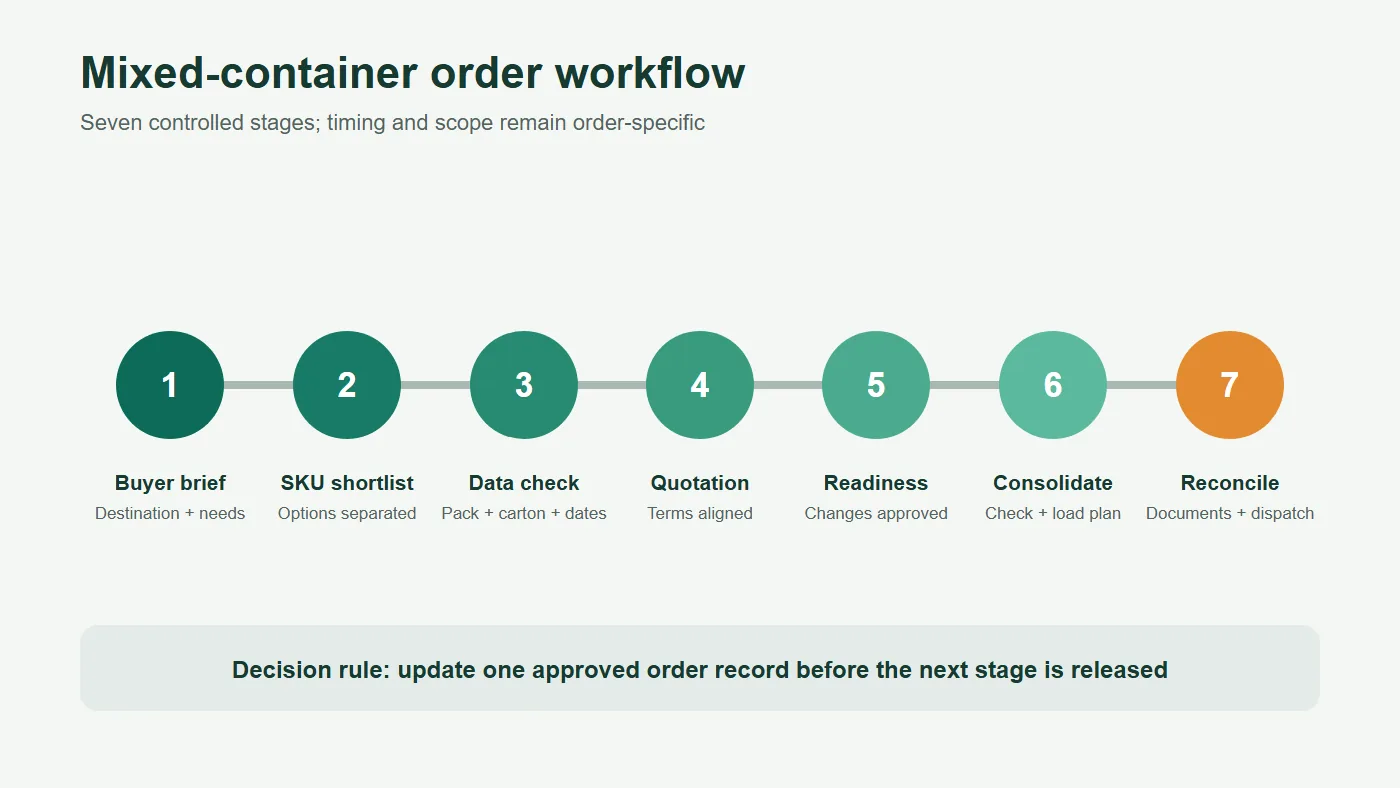
A shared stage and decision-owner record helps keep the assortment, documents and loading plan aligned.
1. Define the buyer brief and destination
Start with the importing country or port, consignee context, target categories or SKUs, estimated quantities, preferred delivery window and any buyer-known import, label or document requirements. If a broker or regulatory adviser has provided instructions, include them early. Destination requirements can change which products remain feasible.
2. Build the SKU shortlist and alternatives
Convert broad requests such as “beverages and personal care” into identifiable product lines. Record brand, variant, retail size, market pack and preferred case quantity where known. Alternatives should be marked as alternatives, not silently substituted into the main list.
3. Confirm pack, case and date data
Verify units per case, carton dimensions and weight, requested case quantity, relevant storage notes and the required date-code or remaining-shelf-life condition. These fields can vary by SKU and lot. A past order, website image or catalogue listing should not be treated as a permanent specification.
4. Align the commercial quotation
The quotation should identify the product and quantity basis, currency, validity, applicable charges and the agreed Incoterms® rule with a named place or port and version. Incoterms® rules allocate important delivery tasks, costs and risks between seller and buyer; they do not replace the full sales contract. Payment method and milestones should be recorded separately.
5. Control readiness and substitutions
As products move through sourcing or production, record whether each line is quoted, conditionally available, confirmed or affected by an exception. If an item changes, explain the replacement and its effect on price, quantity, pack data, labels and documents. The buyer's written decision should update the current order version.
6. Consolidate, check and prepare the load plan
Confirm actual cartons, weights, dimensions, compatibility and any approved labeling or repacking scope. OneDayFMCG can provide labeling and repacking for selected products and projects, subject to feasibility and written scope confirmation before order acceptance. The loading plan should use verified carton data rather than estimates retained from an early quotation.
7. Reconcile documents and dispatch
Compare the approved order, final quantities and loading record against the commercial invoice, packing list and other applicable documents. Vietnam Customs material on export-document digitization highlights the need for consistent data across commercial and packing records. C/O, Health Certificate, Certificate of Free Sale, COA or related documents may be supported on request, depending on product, manufacturer, destination, issuing authority and shipment; they are not a universal standard set.
Data Needed Before Load Planning
A useful load plan starts with a controlled SKU data sheet. At minimum, identify the exact product and pack version, units per carton, carton dimensions, gross and net weight where applicable, quantity, palletization needs, storage or compatibility notes, production or availability window, date condition, label status and document requirements.
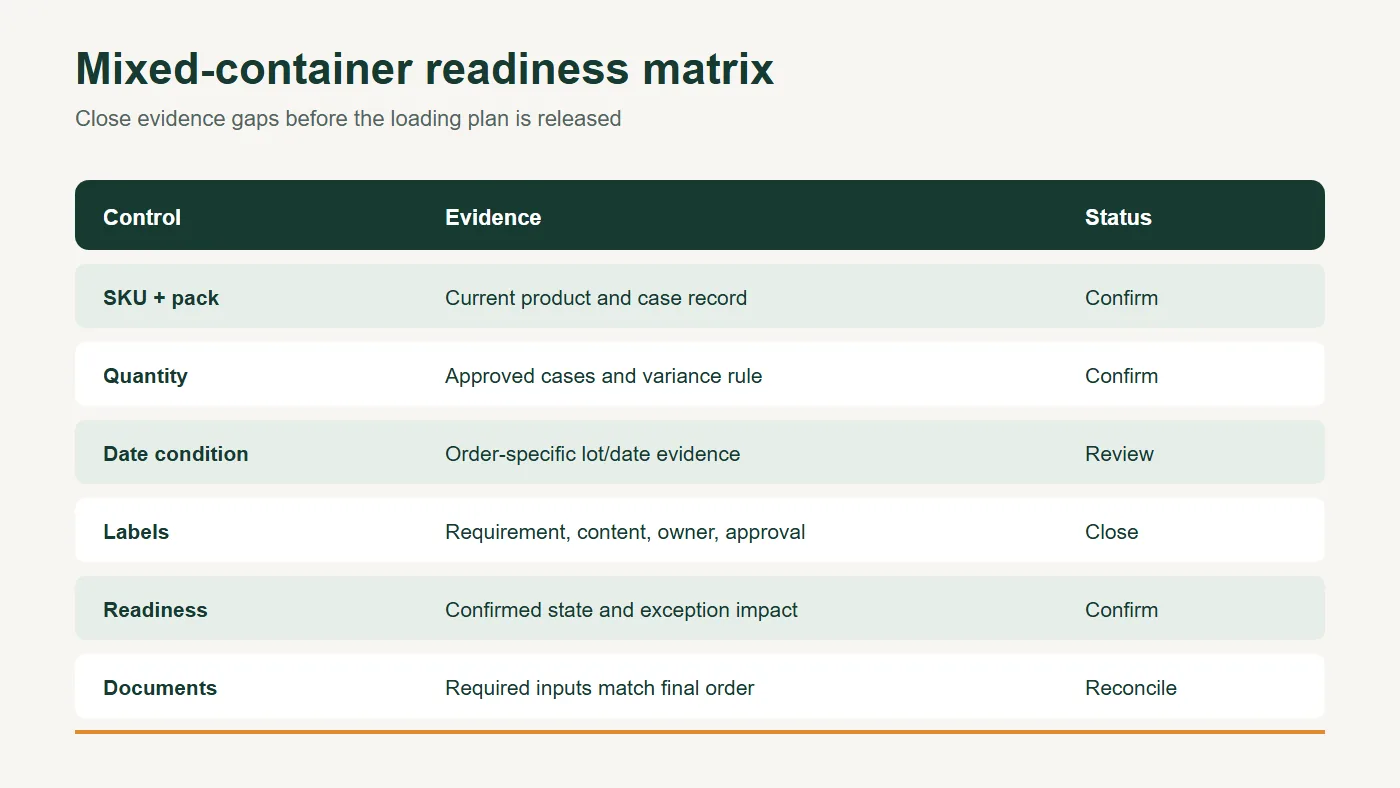
Use one current matrix to identify missing inputs and assign an owner before loading.
| Readiness field | Evidence to confirm | Decision owner |
|---|---|---|
| SKU and pack | Current product name, variant, retail size, artwork language and verified identifier | Buyer and exporter |
| Case data | Units per case, carton dimensions, gross weight and case increment | Exporter / source |
| Quantity | Approved case quantity and treatment of any variance | Buyer |
| Date condition | Order-specific production, expiry or remaining-shelf-life evidence required | Buyer and exporter |
| Label status | Destination requirement, approved content, responsible party and deadline | Buyer / adviser |
| Readiness | Confirmed status and exception affecting the wider assortment | Exporter |
| Documents | Required document, source data, responsible party and acceptance condition | Buyer and exporter |
The matrix should expose uncertainty instead of hiding it. A blank carton dimension, pending label approval or unverified date condition is a decision item. It should not be converted into an invented estimate merely to make the sheet appear complete.
Common Coordination Risks
One line delays the whole group. A mixed shipment shares a loading and document plan. If a critical SKU is not ready, the parties need an explicit decision: wait, reduce the line, approve an alternative or revise the assortment under the agreed commercial terms.
Carton data changes after quotation. A different carton count, dimension or weight can affect quantity and loading assumptions. Recalculate the plan from the confirmed pack evidence and record any commercial impact before release.
Compatibility is reviewed too late. Product value alone does not establish that items can share handling or container conditions. Review crush, leakage, heat, odor, hygiene and regulatory constraints while the shortlist is still adjustable.
Labels or documents miss the decision window. A buyer-country label or conditional certificate may need information from several parties. Late instructions can affect readiness, so define the required evidence, owner and approval deadline at the brief stage.
Unapproved substitutions create mismatches. A changed size or flavor can alter the invoice description, carton count, label and buyer expectation. Never treat a proposed replacement as accepted until the written order record has been updated.
Commercial Terms to Define in Writing
Record the MOQ basis, confirmed assortment, price and currency basis, quotation validity, consolidation or project charges where applicable, and the process for short shipment, cancellation and substitution. If the scope includes selected-product labeling, repacking, OEM, private label or custom packaging, describe the exact responsibility and approval condition in writing.
Specify the Incoterms® rule, named place or port and version—for example, the parties should not leave “FOB” or “CIF” without the agreed location and contractual context. OneDayFMCG may discuss EXW, FCA, FOB, CFR and CIF depending on the order and shipment. Final terms belong in the quotation, Proforma Invoice or applicable sales agreement. L/C and T/T are payment methods and should remain in a separate section.
Also identify who arranges freight, insurance, export and import clearance, destination handling and local delivery under the selected rule and contract. For a broader overview, review the FMCG export services and Shipping & Delivery information; the order-specific written terms remain controlling.
Mixed-Order Readiness Check
Before approving loading, confirm that every included line is identifiable, the requested and confirmed quantities agree, carton data is current, date conditions have evidence, label decisions are closed, compatibility has been reviewed and required document inputs match the final order. Assign an owner and due point to every exception.
A practical release question is: “Can the final quantity, carton and document record be explained from one approved data set?” If not, pause the affected stage and reconcile the difference. This control is more useful than assuming that a full container automatically means the order is ready.
Frequently Asked Questions
What is a mixed-container FMCG order?
It is a full container order made up of multiple approved FMCG product lines under one confirmed assortment and shipment plan. “Mixed” refers to the assortment; it does not mean LCL or unrestricted quantities.
Can different brands and categories ship together?
They may be combined when the products, quantities, sourcing, handling, compatibility, label, document and loading conditions are feasible. Every proposed combination requires order-specific confirmation.
Does a mixed order always reduce freight cost?
No. The result depends on actual quantities, utilization, origin points, handling, route and commercial terms. Assortment breadth can add coordination work, so compare the full order plan rather than assuming an automatic saving.
What information is needed for a consolidation quote?
Provide the destination, product or category shortlist, target quantities, preferred pack details, packaging and label needs, document requirements, delivery window and any broker or buyer-country instructions already known.
What happens if one SKU is not ready?
The parties should assess its effect on the confirmed assortment and decide in writing whether to wait, revise the quantity, approve an alternative or follow another option allowed by the applicable commercial terms.
Planning a mixed-container order? Send the destination, SKU or category shortlist, estimated quantities, packaging and label needs, document requirements and target timing through the OneDayFMCG contact page. The team can assess consolidation feasibility for the specific assortment before order confirmation.
Sourcing FMCG from Vietnam?
Tell us what you are looking for and we will come back with a wholesale offer.
RELATED ARTICLES
View All 14 Oct, 2026
Gum, Candy and Cookies: A Three-Format SKU Triage Checklist
 07 Oct, 2026
How to Source Vietnamese Coffee Wholesale: A Buyer Checklist
 25 Sep, 2026