

Certificate of Origin for Vietnam FMCG Exports: What Buyers Should Prepare
For an FMCG buyer, a Certificate of Origin (C/O) should be treated as a shipment-specific compliance decision, not as a standard form that can be added at the end of an order. The right origin proof depends on the importing country, the product classification, the applicable trade arrangement, the product-specific origin rule, the production evidence and the route accepted by the relevant authorities.
This guide shows the information an importer should prepare before asking a Vietnam exporter to support a C/O. It is a practical coordination framework, not legal or customs advice. Your customs broker, legal adviser and the competent authorities should confirm the requirements for the destination and shipment.

What a Certificate of Origin does
A C/O supports a claim about where goods originate under a relevant legal or trade framework. It may be requested for customs treatment, buyer controls, banking documents or contractual reasons. In some cases, accepted proof of origin may support a claim for preferential tariff treatment. In other cases, a non-preferential origin document may be requested for a different purpose.
Country of shipment and qualifying origin are not automatically the same. Goods can be exported from Vietnam without necessarily meeting a particular rule of Vietnamese origin. For processed FMCG, the answer can depend on the inputs, production steps and product-specific origin rule. A label statement, supplier address or past shipment document does not replace that analysis.
Vietnam's Ministry of Industry and Trade publishes the current legal framework and administrative information. At publication time, the Ministry's page for Circular 40/2025/TT-BCT lists it as effective from 1 July 2025. Buyers should always check the current version and any destination-specific arrangement before relying on a document route.
Is a C/O required for every Vietnam FMCG export?
No single answer applies to every shipment. A C/O or another origin proof may be requested because of the importing country's rules, the tariff treatment being claimed, a letter of credit, the sales contract or the buyer's internal compliance process. Some arrangements permit different proofs or declarations when their conditions are met. A buyer should therefore avoid asking simply for “the Vietnam C/O” without explaining the destination and purpose.
OneDayFMCG can coordinate C/O support on request, depending on the product, factory, destination, issuing authority and shipment. Availability, the applicable route and timing must be checked for the actual order. For the wider shipment file, see our guide to export documents for FMCG shipments from Vietnam and the Export Compliance & Documentation page.
How to determine the appropriate origin-proof route
The safest workflow is sequential. Each answer informs the next check, and a gap early in the process can make later document preparation unreliable.
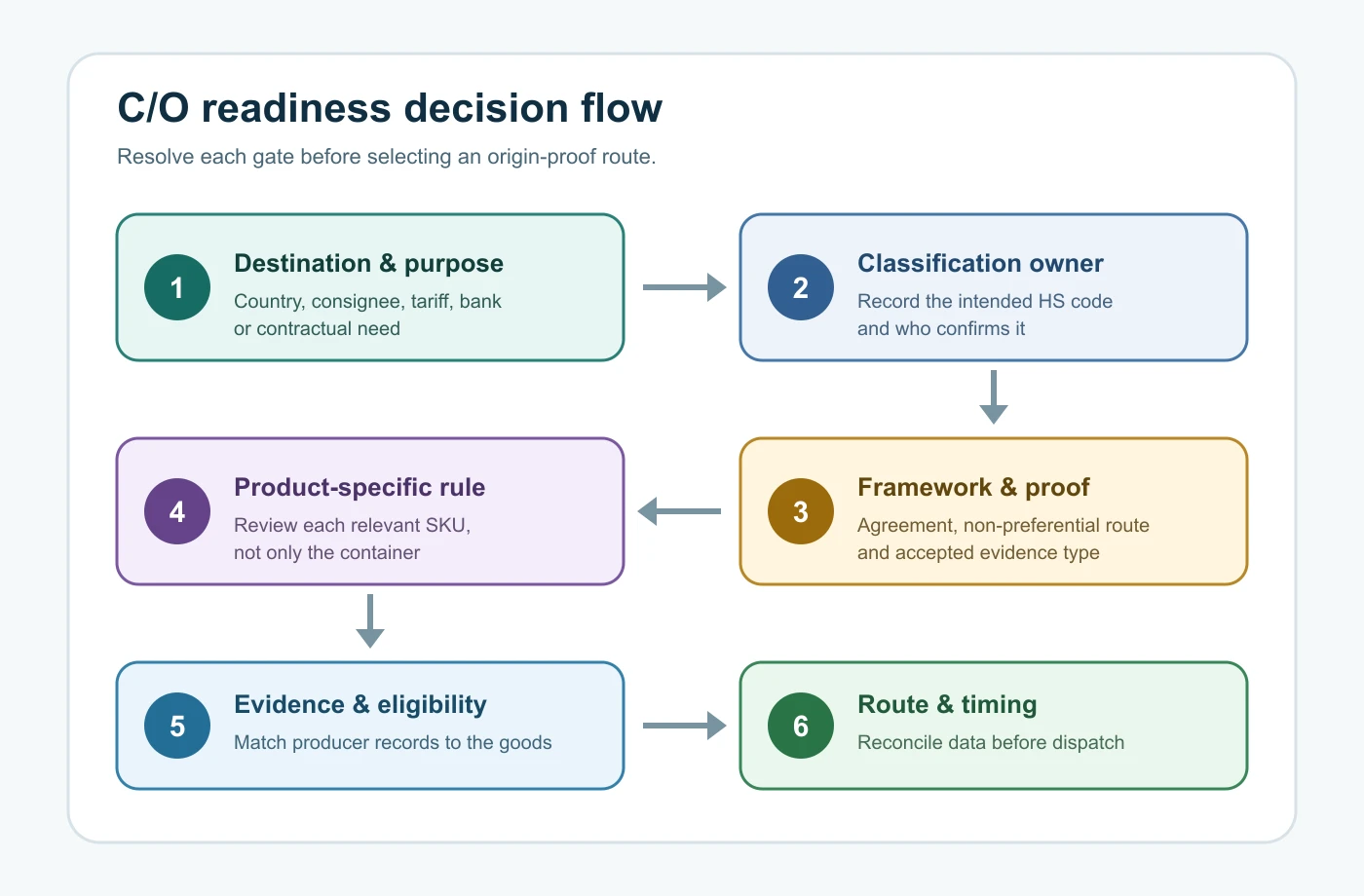
- Confirm the destination and purpose. Identify the importing country and whether the request concerns preferential treatment, non-preferential origin, a bank condition, contract language or another buyer control.
- Assign responsibility for classification. Record the intended HS classification supplied or confirmed by the responsible importer, broker or adviser. OneDayFMCG does not make the final customs classification decision for the destination.
- Check the applicable framework and accepted proof. The buyer or broker should identify the relevant trade arrangement, if any, and the proof or form accepted for that route. The Vietnam Trade Repository provides official materials on tariff nomenclature, rules of origin, procedures and trade agreements, but the shipment parties remain responsible for applying the current requirements correctly.
- Review the product-specific origin rule. Do not assume that all products in one mixed container use the same rule. The product classification, manufacturing process and material inputs may lead to different evidence needs by SKU.
- Confirm evidence and eligibility. The exporter and producer may need to coordinate product descriptions, production information, material records and other supporting documents. The available evidence must match the actual goods and shipment.
- Confirm the filing route and timing. Check who may apply or make a permitted declaration, what system or authority applies, and when the data must be ready. Allow time to reconcile the invoice, packing list, transport information and origin file before dispatch.
This sequence does not guarantee that a C/O will be issued or that preferential treatment will be granted. It creates an auditable set of questions for the importer, exporter, producer and customs adviser to resolve.
Information buyers should provide early
Origin coordination improves when the request arrives with usable shipment facts. “Please include C/O” is not enough because it leaves the exporter guessing about the legal purpose and expected route.
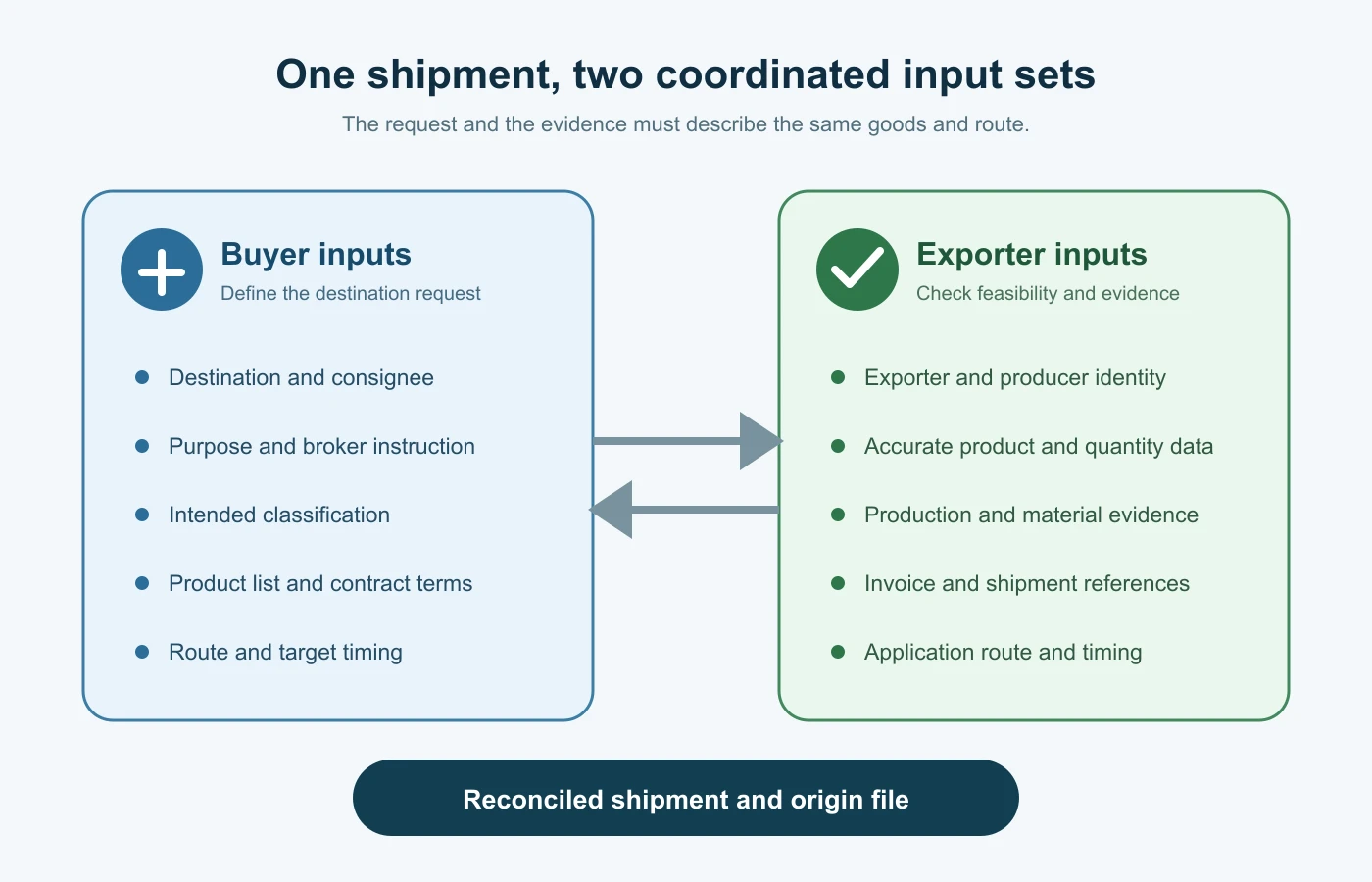
| Buyer input | Why it matters | Who should confirm it |
|---|---|---|
| Importing country and consignee | Defines the destination framework and clearance context. | Buyer/importer |
| Purpose of the origin request | Separates tariff, customs, bank, contract and internal-control needs. | Buyer, broker or bank as relevant |
| Intended HS classification | Supports the correct product-specific rule review. | Responsible importer/broker/adviser |
| Requested arrangement or proof | Prevents the exporter from selecting a form based on assumption. | Buyer/broker, subject to authority acceptance |
| Product and SKU list | Different goods may have different origin evidence requirements. | Buyer and exporter together |
| Invoice, contract and bank conditions | Keeps names, references and documentary language consistent. | Buyer and bank/contract parties |
| Transport route and target timing | May affect documentary checks and the preparation schedule. | Buyer, forwarder and exporter |
For a consolidated order, send the product list in a structured format and flag any SKU whose factory, formulation or pack configuration is still changing. Our multi-brand container planning guide explains how to keep SKU and approval data aligned before booking.
Information the exporter and producer may need to coordinate
Once the buyer's instructions are clear, the exporter can check feasibility with the producer and relevant parties. Depending on the route, the working file may include exporter and producer identity, accurate product descriptions, quantities, invoice references, packaging and marks, shipment details, origin criteria and supporting production or material information.
The exact evidence is not universal. It may differ across products from separate factories even when they travel in the same container. Evidence should be current and traceable to the SKU and shipment; a C/O from another lot, an unrelated product specification or a generic “made in Vietnam” statement should not be reused as if it proves the new claim.
Product availability, pack configuration, label needs and documentary feasibility should be checked together. Buyers can review our FMCG product range, then share a shortlist so the relevant factories and records can be assessed before commercial terms are finalized.
Vietnam's electronic C/O environment
The Ministry of Industry and Trade operates the official eCoSys electronic C/O system. The Ministry also publishes an official administrative procedure page for C/O issuance. These are the appropriate places to verify current system information, legal bases and procedural requirements.
An electronic portal does not remove the need to establish origin or reconcile shipment data. It is the channel for a process; it is not automatic approval. The applicant's eligibility, the relevant origin rule, the supporting file and the competent authority's review still matter. Because official procedures can change, this article deliberately avoids a click-by-click filing guide.
Common C/O planning mistakes
- Equating shipment with origin: export from a Vietnam port does not by itself establish qualifying Vietnamese origin.
- Choosing a form first: the destination, classification, applicable arrangement and accepted route should be checked before a form is requested.
- Using inconsistent data: descriptions, quantities, invoice references, parties and dates should agree across the commercial and origin files.
- Starting after goods are ready: missing production or material evidence may not be recoverable quickly at the shipping stage.
- Copying a past shipment: a previous C/O does not automatically prove a new SKU, factory, formulation or lot.
- Assuming preference is guaranteed: the importing authority decides whether the claim and proof meet its requirements.
C/O readiness checklist for importers
- The importing country, consignee and purpose of the origin request are confirmed.
- A responsible party has reviewed the intended HS classification.
- The relevant agreement or non-preferential route and accepted proof have been checked.
- The product-specific origin rule has been reviewed for each relevant SKU.
- The exporter and producer have confirmed whether supporting evidence is available.
- Product descriptions, parties, quantities and references can be reconciled across documents.
- The shipment route and documentary timing are known.
- The buyer or broker has completed a final review before dispatch.
Shipping terms and documentary timing should also be coordinated with the current Shipping & Delivery Policy and Policies. These pages explain the operating framework; they do not replace destination-specific customs advice.
Frequently asked questions
Is a Certificate of Origin required for every Vietnam FMCG export?
No. The need depends on the importing country's rules, the treatment being claimed, the contract, banking conditions and other shipment-specific requirements. Confirm the purpose with the buyer's broker or responsible adviser.
Does shipping from Vietnam automatically qualify goods as Vietnamese origin?
No. Shipment location is not automatically qualifying origin. The applicable rule may consider product classification, materials and processing, among other factors.
Who determines the correct C/O form or proof?
The responsible shipment parties should use the current agreement and official requirements, with confirmation from the buyer's customs broker, adviser and competent authorities as appropriate. OneDayFMCG will not select a form solely from a general request.
What should an importer provide for C/O preparation?
Provide the destination, consignee, purpose, intended classification, requested arrangement or proof if advised, product list, contract or bank conditions, transport route and timing. Earlier instructions allow a better feasibility check.
Can a C/O be applied for electronically in Vietnam?
Vietnam's Ministry of Industry and Trade operates eCoSys and publishes electronic administrative procedures. The applicable route, eligibility, evidence and current requirements still need to be verified for the specific shipment.
Prepare the origin check before order confirmation
Share the destination, product list, buyer or broker C/O instruction, intended classification, route and shipment details with OneDayFMCG early. We can coordinate a feasibility check with the relevant parties before order confirmation, while keeping the result conditional on the product, factory, destination, issuing route and current official requirements.
Contact OneDayFMCG to discuss your shipment and documentation inputs.
Sourcing FMCG from Vietnam?
Tell us what you are looking for and we will come back with a wholesale offer.
RELATED ARTICLES
View All 14 Oct, 2026
Gum, Candy and Cookies: A Three-Format SKU Triage Checklist
 07 Oct, 2026
How to Source Vietnamese Coffee Wholesale: A Buyer Checklist
 25 Sep, 2026