
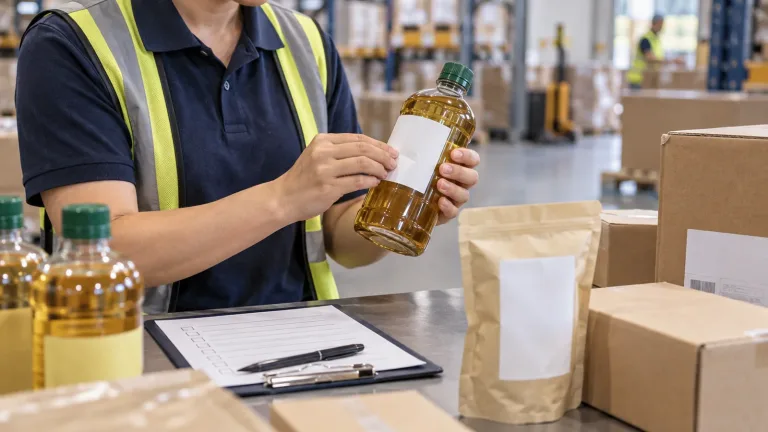
FMCG Product Labels and English Sub-Labels for Export Orders
Label work for an FMCG export order should start with the destination and the exact SKU, not with a generic sticker template. A bottle size, flavour, formula, pack version or importer detail can change what belongs on a supplementary label and where it can be placed. This guide sets out a controlled workflow for buyers arranging FMCG labeling service Vietnam export projects with OneDayFMCG.
“English sub-label” is a useful commercial description, but English is not automatically the required language for every market. Language, mandatory fields, responsible-party details, claims, placement and timing depend on the destination, product and current rules. The buyer or importer should obtain the applicable requirements from the destination authority or a qualified adviser and approve the final content. OneDayFMCG can review operational feasibility for selected products and projects after those inputs are provided.
Original label, translation and supplementary label
The original label is the information and artwork supplied with the product by its manufacturer or responsible producer. It may include the product identity, ingredients, pack quantity, use and storage information, date or batch coding, barcode and manufacturer details. A translation should faithfully map verified source information into the required language; it should not introduce a new claim, stronger promise or different product meaning.
A supplementary label is additional information attached to or supplied with a product under an agreed market-specific arrangement. It may be used when the destination requires content that is not already presented in the required form or language. It is not a universal cure for an incomplete or unsuitable original pack. Some issues may require different manufacturer artwork, registration, testing, prior approval or a product that is already intended for that destination.
Vietnam’s official legal sources show why source accuracy and traceability matter. The Vietnam Trade Repository’s food-safety law entry covers labeling and requires accurate product information for food, while the national legal database records the current framework for goods labels and amendments. Buyers should use these as Vietnam-side references, then confirm destination requirements with the relevant authority. See the Vietnam Trade Repository food-safety law entry and the National Database of Legal Documents entry for Decree 111/2021/ND-CP. This article is an operational guide, not a legal opinion.
Information the buyer should confirm
Before artwork begins, prepare one instruction set for each market and product group. Depending on the applicable rules, the working file may need the legal product name, ingredient and allergen information, nutrition data, net quantity and unit, manufacturer and origin details, importer or responsible-party text, storage and use directions, date presentation, warnings, registrations or permitted marks. This is a planning list, not a universal mandatory-field checklist.
Every field should have a source. Manufacturer artwork or specifications may support product facts; the importer supplies its own legal identity and market instructions; a destination authority or qualified adviser confirms local requirements. If the buyer requests a claim, symbol or certification reference, the approval record should also identify the evidence and the exact SKU or facility to which it applies. No mark should be copied merely because it appeared on another product.
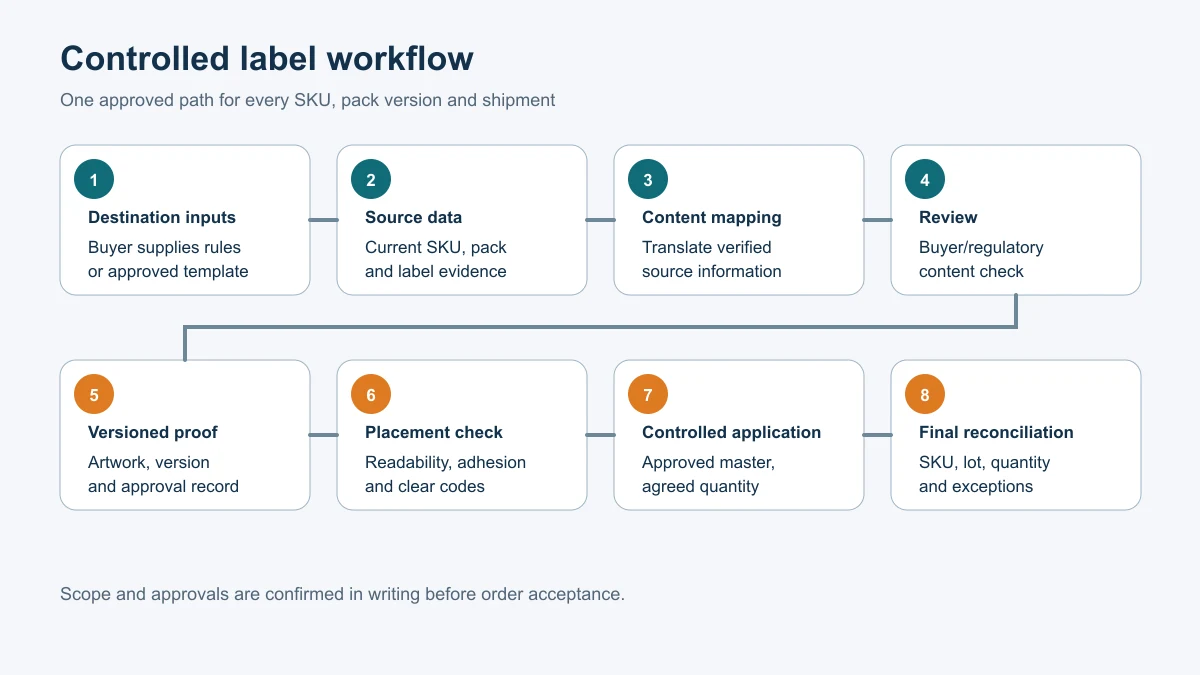
An eight-step label production workflow
- Destination inputs: the buyer provides the country, current rule set or buyer-approved template, responsible-party details and any product-specific instructions.
- Source data: the supplier identifies the current SKU, pack size, barcode, pack version and available manufacturer information. Photos should show all label panels and the date-code area.
- Content mapping: each requested field is mapped to its verified source. Translation should preserve meaning, units, warnings and qualifications.
- Review: the buyer, importer or appointed adviser checks the mapped content against current destination requirements and resolves gaps.
- Versioned proof: artwork receives a unique version number and date. The proof shows exact dimensions and the proposed physical position.
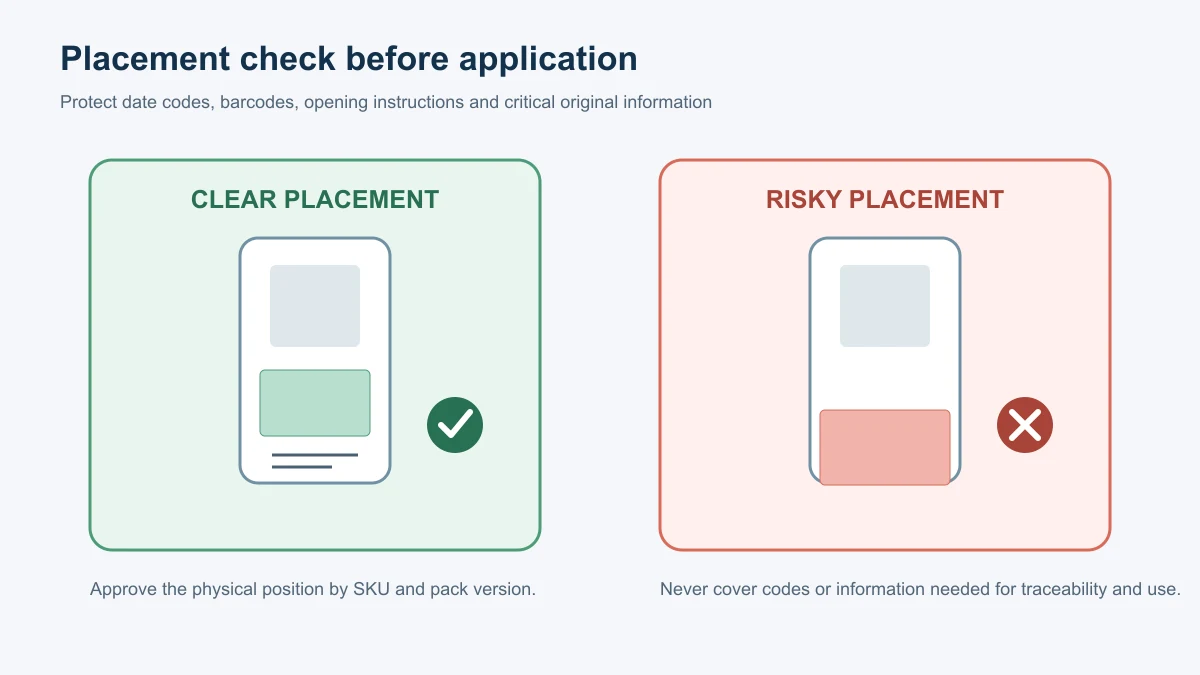
- Placement test: a physical sample is checked for readability, adhesion, curvature, seams and clear access to original codes, barcode and opening instructions.
- Controlled application: only the approved master is released for the agreed SKU and quantity. Superseded files are removed from the working station.
- Reconciliation: applied quantities are matched to SKU, lot and order lines before loading; exceptions are photographed and recorded.
Approve early enough to allow correction. Label work started after final packing creates avoidable pressure: a change can require reprinting, reopening cartons and repeating inspection. OneDayFMCG reviews labeling or repacking only for selected products and projects, subject to feasibility and a written scope before order acceptance. The service is not automatically available for every SKU.
Build a SKU-level label matrix
A matrix turns emails and artwork files into one operational control record. Use one row per SKU and pack version, even when products share a family name. A practical matrix can contain the following fields:
| Control field | What to record |
|---|---|
| Product identity | SKU, barcode, exact pack size and current pack version |
| Market | Destination, language and importer/responsible-party text |
| Label control | Label version, dimensions, approved fields and placement |
| Code protection | Date-code and barcode location that must remain clear |
| Approval | Approver, approval date and supporting instruction reference |
| Execution | Quantity applied, lot/SKU reconciliation and exception note |
The matrix is especially important in a mixed-container order. Similar-looking products can have different weights, flavours, warnings or importer text. A single “approved” PDF stored without a SKU mapping does not prove that the correct version reached the correct pack.
Common labeling errors to prevent
- Wrong SKU or old artwork: a previous size or formula remains on the workstation and is applied to the new pack.
- Translation changes meaning: a qualification is dropped, a unit is converted incorrectly or a marketing phrase becomes an unsupported product claim.
- Critical information is covered: the label hides a date code, batch code, barcode, opening instruction, safety warning or original identity.
- Importer text is incomplete: the buyer supplies an informal trading name while the market requires a specific legal responsible-party format.
- Claims are copied without review: nutrition, cosmetic, environmental, certification or origin statements move from one SKU or country to another without evidence.
- Documents disagree: the label name, commercial invoice, packing list and registration use different descriptions or pack units.
Date codes and shelf-life statements
Date handling is a high-risk control point. Confirm the type of code, format, physical location and legibility on the actual pack. Then connect it to the buyer’s remaining-shelf-life threshold by SKU and lot. A supplementary label must not alter, obscure or reinterpret a manufacturer code in a way that could misrepresent production, expiry or traceability.
If a translated explanation of the format is requested, it should be checked against the original code and approved instructions, with the original remaining visible where required. OneDayFMCG does not change date codes or use a label to make short-dated stock appear newer. Our approach to SKU-level checks is described in the Product Quality & Shelf Life Policy.
Responsibility and approval record
A clear responsibility table is more useful than a vague instruction to “make the label compliant.” Unless a written contract states otherwise, the buyer/importer owns destination requirements and final content approval. The supplier/exporter coordinates available source data and the agreed application. A translator is responsible for the assigned translation, while the appointed reviewer determines whether the content is acceptable for the destination.
Keep a record of who supplied source data, translated, reviewed, approved, printed, applied and inspected the labels. Link each action to a version and date. If one party changes importer text or an artwork panel after approval, issue a new version rather than overwriting the previous file. This audit trail helps resolve questions before loading and supports investigation if a mismatch is discovered later.
Pre-shipment label inspection
Inspection should compare physical packs with the approved master and SKU matrix. The parties can agree an appropriate sample method based on quantity and risk. At minimum, inspect the correct SKU and version, placement, adhesion, readability, pack integrity, barcode clearance and visibility of date and batch codes. Photograph representative units and record exceptions, rework and final release.
Label inspection is one part of the shipment file. Product descriptions should also align with the packing list and commercial invoice, and any supporting document should match the same SKU identity. For the wider export document workflow, see Export Compliance & Documentation, the guide to FMCG export documents from Vietnam and the separate explanation of Certificates of Origin.
How to request a feasibility review
Start with products that can be identified precisely in the current FMCG catalogue. Then send the destination, buyer-approved label rules or template, SKU list, importer text, quantities and required timing. OneDayFMCG will review the proposed scope together with the product, packing and shipment requirements described in our FMCG Export Services.
Feasibility depends on the actual SKU, packaging surface, quantity, timing, source-data availability and destination instructions. A review does not replace the buyer’s regulatory advice or final approval. To discuss a specific order, contact OneDayFMCG with the SKU-level information rather than a generic request for “English labels.”
Frequently asked questions
Is an English sub-label required for every export market?
No. The required language and presentation depend on the destination, product and current rules. The buyer/importer should confirm the requirement with the relevant authority or qualified adviser.
Who is responsible for approving label content?
Unless a written contract states otherwise, the buyer/importer supplies destination requirements and approves the final content. OneDayFMCG coordinates available source information and agreed application for a feasible project.
Can one label template be used for every SKU?
Not safely by default. Size, formula, barcode, source artwork, warnings and date-code location can differ. Each SKU and pack version should have its own matrix row and approval.
When should supplementary labels be approved?
Approve the content, artwork version and physical placement before production or final packing whenever possible. Late changes can cause reprinting, rework and shipment delay.
What should be checked after labels are applied?
Check the correct SKU and version, placement, adhesion, readability, pack integrity, barcode access and visibility of original date and batch codes. Reconcile applied quantities and document exceptions before release.
Sourcing FMCG from Vietnam?
Tell us what you are looking for and we will come back with a wholesale offer.
RELATED ARTICLES
View All 14 Oct, 2026
Gum, Candy and Cookies: A Three-Format SKU Triage Checklist
 07 Oct, 2026
How to Source Vietnamese Coffee Wholesale: A Buyer Checklist
 23 Sep, 2026