

Export Documents Required for FMCG Shipments from Vietnam
The documents required to export FMCG from Vietnam cannot be reduced to one universal pack. The right list depends on the product, HS classification used by the responsible party, destination-country rules, buyer and broker instructions, contract and payment terms, transport mode and the authorities involved. A commercial invoice and packing list are commonly used, but a Certificate of Origin, health document, analysis record or import permit may be conditional. This guide gives importers a practical way to identify, assign and reconcile documents before a shipment reaches the point where changes become expensive.
Important: this is an operational planning guide, not a legal or customs determination for a specific shipment. The buyer should confirm destination requirements with its importer, customs broker or relevant authority, while the exporter verifies what can be supported for the selected products and order.
Start With a Document Requirement Matrix
Begin at enquiry stage, not after the goods are ready. Create one document matrix that connects every requested record to the product, destination, issuer, owner and decision date. The matrix should identify who confirms the HS classification, who supplies source data, who prepares the draft, who approves it and whether an original, copy or electronic record is acceptable.
| Field | Question to record | Why it matters |
|---|---|---|
| Product or SKU | Which exact product, pack and market version does the requirement cover? | Prevents evidence for one item being reused for another. |
| Destination | Which country, port and importer process applies? | Separates export-side records from destination obligations. |
| Document | What is the precise name and acceptance condition? | Avoids vague requests such as “all certificates.” |
| Issuer or preparer | Exporter, manufacturer, carrier, authority, laboratory or buyer? | Shows whether the requested party can actually produce it. |
| Data owner | Who confirms classification, origin, ingredients, quantities or consignee details? | Stops drafts being built from assumptions. |
| Timing | When is feasibility checked, the draft approved and the final issued? | Exposes dependencies before order acceptance. |
| Format | Original, certified copy or electronic record? | Supports bank, broker and courier planning. |
OneDay FMCG's Export Compliance & Documentation Policy explains the public framework for document support and buyer responsibilities. The actual scope remains product-, destination- and shipment-specific.
Separate Commonly Used Records From Conditional Documents
Commercial and transport records are commonly used to describe and move the transaction. Conditional documents establish a specific origin, product, health, inspection or market requirement. The distinction matters because a document being common does not make its form identical for every order, while a conditional certificate should not be promised before eligibility and issuance are checked.
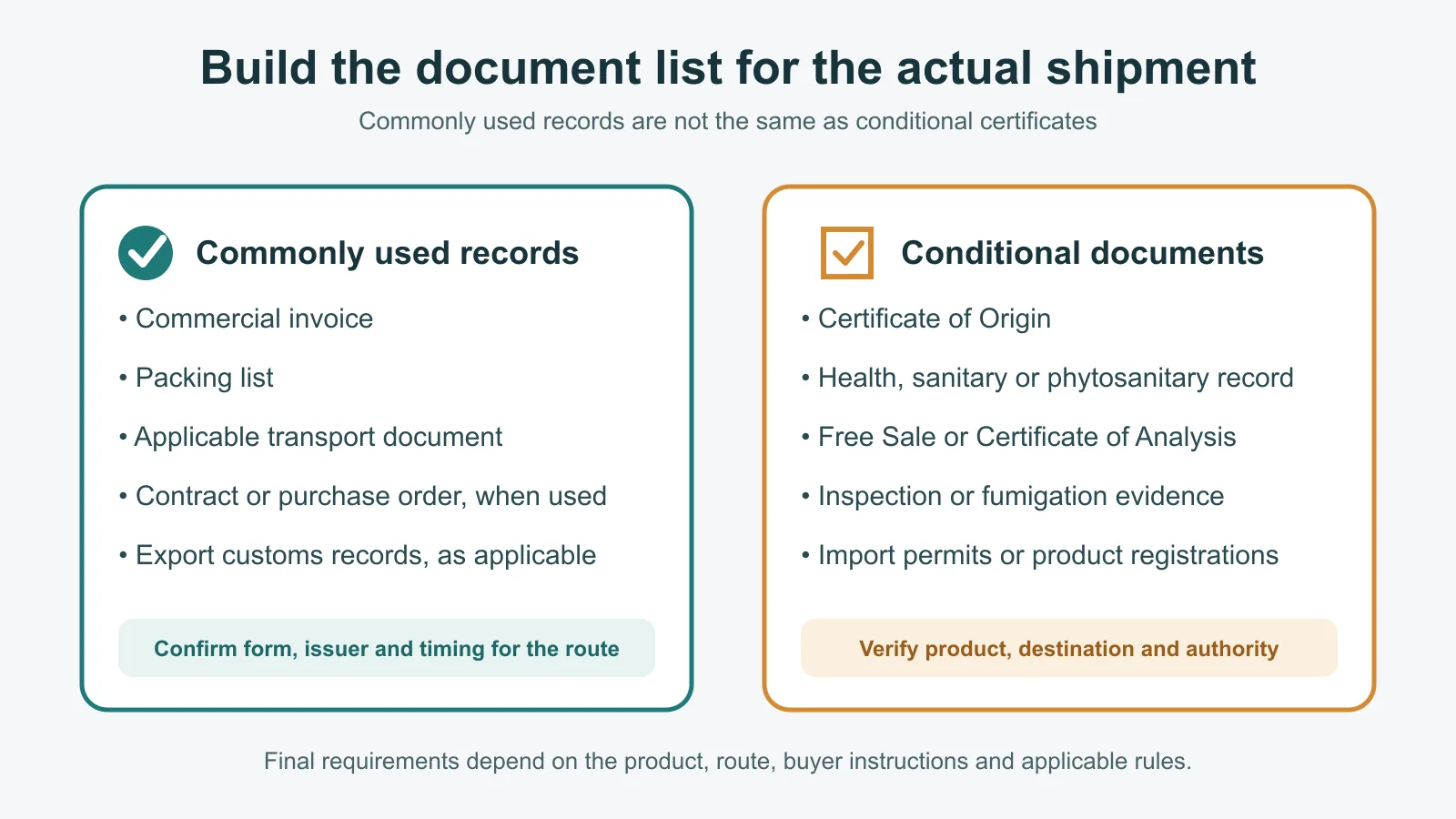
Use the left side as a starting point and the right side only where the product, destination or transaction requires it.
Commonly used commercial and transport records
- Commercial invoice: identifies the parties, goods, quantities, values, currency and agreed commercial basis.
- Packing list: records package counts, units, weights, dimensions or marks as applicable to the shipment.
- Transport document: may be a bill of lading, sea waybill, air waybill or another record appropriate to the transport arrangement.
- Contract, purchase order or Proforma Invoice: used according to the parties' commercial process and payment structure.
- Export customs records: prepared and filed according to the applicable Vietnamese procedure and shipment structure.
These descriptions are functional, not a guarantee that every field or record applies in exactly the same way. The agreed Incoterms® rule allocates important delivery tasks, costs and risks; it is separate from payment methods such as L/C or T/T. Final terms should be recorded in the quotation, Proforma Invoice or applicable sales agreement.
Conditional product, origin and destination documents
A Certificate of Origin, Health Certificate, Sanitary or Phytosanitary Certificate, Certificate of Free Sale, Certificate of Analysis, inspection evidence, fumigation record or other certificate may be relevant only when the product and destination conditions require it. Import permits, product registrations or notifications may sit with the importer or another responsible party. Brand authorization or conformity evidence should also be requested only where commercially or legally relevant and supported by the correct owner.
OneDay FMCG may support C/O, Health Certificate, Certificate of Free Sale, COA and related documents on request. Availability depends on the product, manufacturer, destination, issuing authority and shipment. No named certificate should be treated as automatically available for every SKU.
Assign the Preparer, Issuer and Approver
“Who provides the document?” is often too broad. The exporter may prepare a commercial draft, a manufacturer may control ingredient or batch data, a carrier may issue the transport record, and an authority or other authorised issuing body may decide whether a certificate can be issued. The buyer or broker may then approve the content for destination use.
| Document group | Typical preparer or issuer | Buyer input | When confirmed | Conditional? |
|---|---|---|---|---|
| Commercial invoice | Seller/exporter | Consignee, values and agreed terms | Before final issue | Form and fields vary |
| Packing list | Seller/exporter using final packing data | Marks or receiving needs | After packing data is stable | Fields vary |
| Transport document | Carrier or forwarder | Consignee, notify party and release instructions | Draft before final issue | Transport-specific |
| Certificate of Origin | Competent or authorised issuing body | Requested form and destination purpose | Eligibility checked before order | Yes |
| Product or health record | Manufacturer, laboratory or authority as applicable | Destination acceptance criteria | Feasibility before order | Yes |
| Import permit or registration | Importer or destination authority | Buyer/importer responsibility | Before shipment commitment | Market-specific |
The contract structure and applicable official rules control final responsibility. A template or prior shipment can show format, but it does not prove that the same document is valid for the current product, route or date.
Freeze Source Data Before Draft Reconciliation
Document accuracy starts with controlled source data. Freeze the approved product name, SKU or variant, retail pack, units per carton, carton count, net and gross weight, shipping marks, value basis, parties and consignee details before final drafts are reconciled. Record which party owns the HS classification and origin statement instead of copying them from a similar item.
For a multi-brand or mixed-container order, use one version-controlled master SKU list. A post-freeze substitution can affect product descriptions, quantities, weights, values, marks, origin analysis and conditional certificates. The change should identify the affected document, owner, approver and revised version.
The multi-brand container planning guide explains how a master SKU sheet and approval gates connect the assortment to commercial, loading and document decisions.
Follow a Six-Stage Document Timeline
Document work is not a single task at the end of loading. It moves through six decision stages, and different records become possible only after the required source data exists.
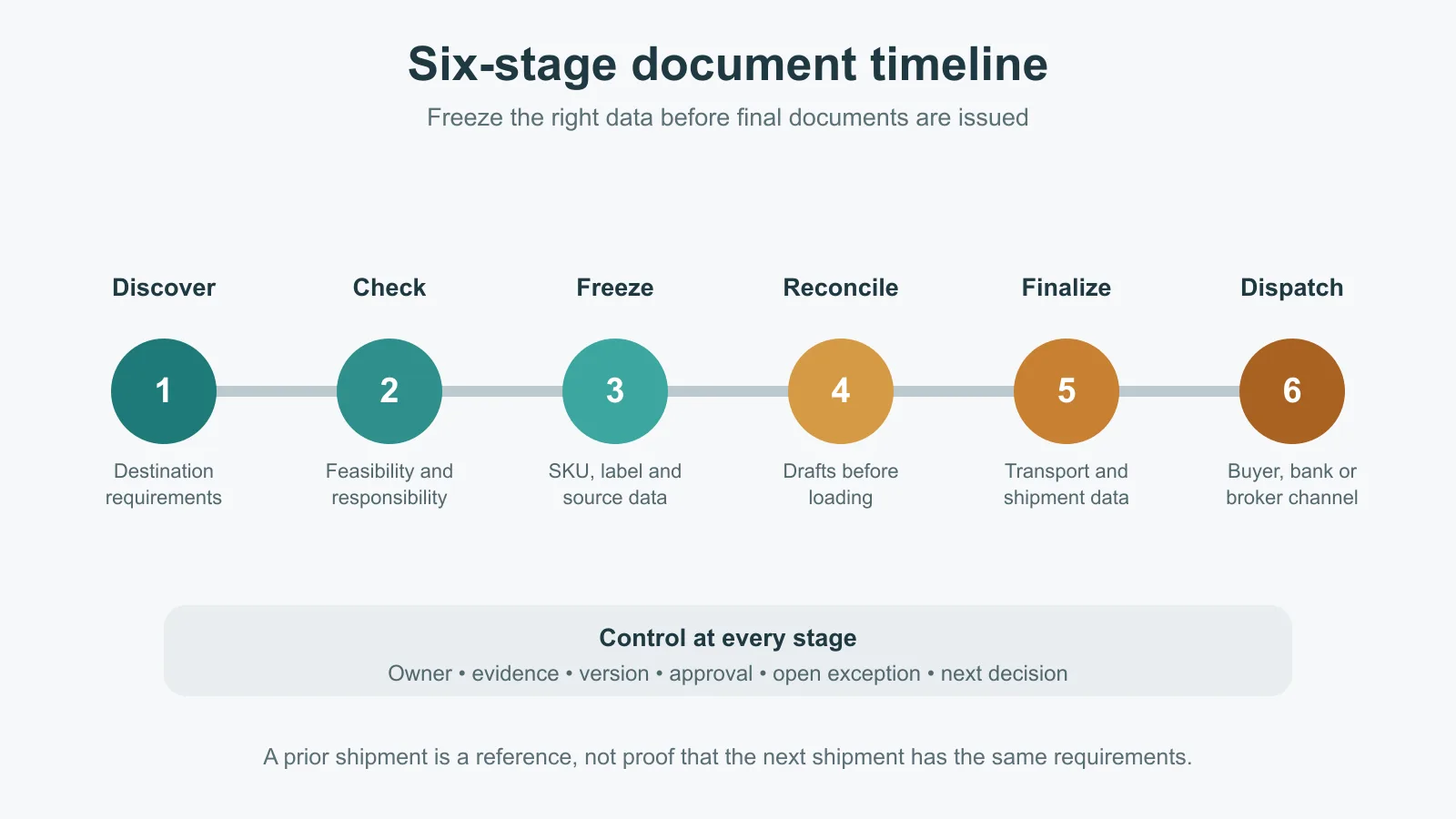
At every stage, record the owner, evidence, version, approval and open exception.
- Requirement discovery: collect the destination, buyer/broker checklist, product shortlist, proposed classification owner, label needs, payment structure and delivery term.
- Feasibility and responsibility check: verify which documents may be supported, who issues them and what data or eligibility is still missing.
- Product and label freeze: lock the approved SKU, pack, artwork and source data used by drafts.
- Pre-loading reconciliation: compare quantities, packages, weights, marks, parties and requested statements across draft records.
- Post-loading finalisation: update the final transport and shipment information when it becomes available.
- Controlled dispatch: release originals or electronic records to the buyer, bank or broker through the agreed channel.
Reconcile the Same Facts Across Every Record
Consistency checks should cover the exporter and consignee identity, product description, quantity and unit, carton count, net and gross weight, value, currency, shipping marks, invoice and shipment dates, origin statement and classification where used. Consistency does not prove substantive eligibility, but inconsistency can create avoidable questions, amendments or clearance delays.
Use a line-by-line check rather than relying on document totals alone. For example, a total carton count may agree while one SKU is assigned the wrong unit, description or weight. A buyer should also compare the approved quotation and final assortment against the document pack, not only compare one final document with another.
Avoid Common Document Planning Mistakes
- Discovering a conditional certificate only after products or labels are committed.
- Assuming a document used on a previous shipment is still required or acceptable.
- Requesting “all certificates” without naming the product, purpose or authority.
- Using inconsistent company names, pack units, product descriptions or shipping marks.
- Treating a draft, sample or manufacturer template as a final shipment record.
- Assigning HS classification or destination compliance to an unspecified party.
- Opening an L/C before checking whether its document conditions can be met.
- Changing a SKU after freeze without checking every dependent record.
For transport responsibilities and timing assumptions, review the Shipping & Export Logistics Policy. Buyers should keep payment-method requirements separate from the selected delivery term.
Use a Ten-Point Buyer Pre-Shipment Checklist
- Confirm the destination, importer and broker instructions.
- Identify the exact SKU, market pack and label version for every line.
- Name the owner of the HS classification and destination requirement check.
- List each requested document, purpose, issuer and acceptance condition.
- Check document feasibility before accepting the order scope.
- Record the agreed Incoterms® rule separately from L/C, T/T or other payment terms.
- Freeze quantities, packages, weights, marks and party details before final drafts.
- Reconcile every line across the commercial, packing and transport records.
- Close exceptions and approve the correct version in writing.
- Confirm the final delivery channel for originals or electronic records.
Importers building a broader order can start with the FMCG Products hub and review the order-specific consolidation scope on the FMCG Export Services page.
Frequently Asked Questions
What documents are commonly used for an FMCG export shipment from Vietnam?
A commercial invoice, packing list, applicable transport document and export customs records are commonly used, but their exact form and supporting records depend on the transaction and shipment. Product, origin or destination certificates are conditional.
Is a Certificate of Origin required for every shipment?
No. The need, form and eligibility depend on the product, destination, applicable origin rules and buyer requirements. A competent or authorised issuing body determines whether the applicable conditions are met.
Who confirms the importing country's document requirements?
The buyer or importer should confirm destination requirements with its broker or relevant authority. The exporter then checks what can be supported for the selected product and shipment and records responsibilities in writing.
When should document requirements be finalized?
Identify them at enquiry stage and confirm feasibility before order acceptance. Freeze source data before final draft reconciliation, while allowing transport details that only exist after loading to be completed at the appropriate stage.
Can shipment documents be issued electronically?
Sometimes. Acceptance depends on the document, issuer, carrier, bank, buyer and destination process. Confirm whether an original, copy or electronic record is acceptable before dispatch planning.
Prepare a Reviewable Document Request
Send OneDay FMCG the destination, exact product or SKU list, intended classifications and responsible party, buyer or broker document checklist, label requirements, proposed Incoterms® rule, payment method and target timing through the Contact page. The team can review which documents may be supported for the proposed order, identify open information and build a shipment-specific matrix before acceptance.
Planning references: Vietnam Trade Repository, Ministry of Industry and Trade public-service procedure, Vietnam Customs research on export-document digitisation and ICC Incoterms® 2020.
Sourcing FMCG from Vietnam?
Tell us what you are looking for and we will come back with a wholesale offer.
RELATED ARTICLES
View All 14 Oct, 2026
Gum, Candy and Cookies: A Three-Format SKU Triage Checklist
 07 Oct, 2026
How to Source Vietnamese Coffee Wholesale: A Buyer Checklist
 25 Sep, 2026