

How to Build a Multi-Brand FMCG Container Order
A multi-brand FMCG container order should begin with a market brief, not a catalogue count. Adding more brands or SKUs can widen the assortment, but it also increases the number of pack records, case quantities, label checks, handling constraints and buyer decisions that must remain aligned. The objective is therefore not to maximise variety. It is to build a justified assortment that can be reviewed, quoted, consolidated and documented as one controlled shipment.
This guide gives importers and category managers a practical framework for that work. It focuses on assortment architecture and load-ready information. For the physical consolidation process, see the mixed-container FMCG guide. For the commercial minimum, review the FMCG MOQ guide: OneDay FMCG's standard MOQ is one mixed container, with no separate fixed minimum per SKU, carton or pallet when the confirmed assortment can complete that container.
Start With the Market and Channel Brief
Before selecting products, define where and how they are expected to sell. Record the destination country and port, buyer type, sales channels, intended customer segments, category priorities, pack preferences and target shipment window. A supermarket, wholesale network, convenience channel and foodservice buyer may require different retail formats, case sizes, label information and replenishment logic.
State any known import, label, registration, shelf-life or document requirements at the beginning. Also identify the proposed Incoterms® rule separately from the payment method. ICC explains that Incoterms® 2020 rules allocate costs, risks and obligations between buyer and seller; the selected rule should be named in the quotation or applicable agreement rather than used as a general shipping label.
The brief should distinguish requirements from preferences. For example, an artwork language required by the destination is a gate, while a preferred bottle size may permit an approved alternative. This distinction prevents teams from treating every field as negotiable or, conversely, blocking the entire order because a non-critical preference changes.
Build a Three-Tier Assortment
Use three tiers to give the assortment a demand logic. The tiers do not prescribe fixed percentages; their purpose is to make the reason for each line visible.
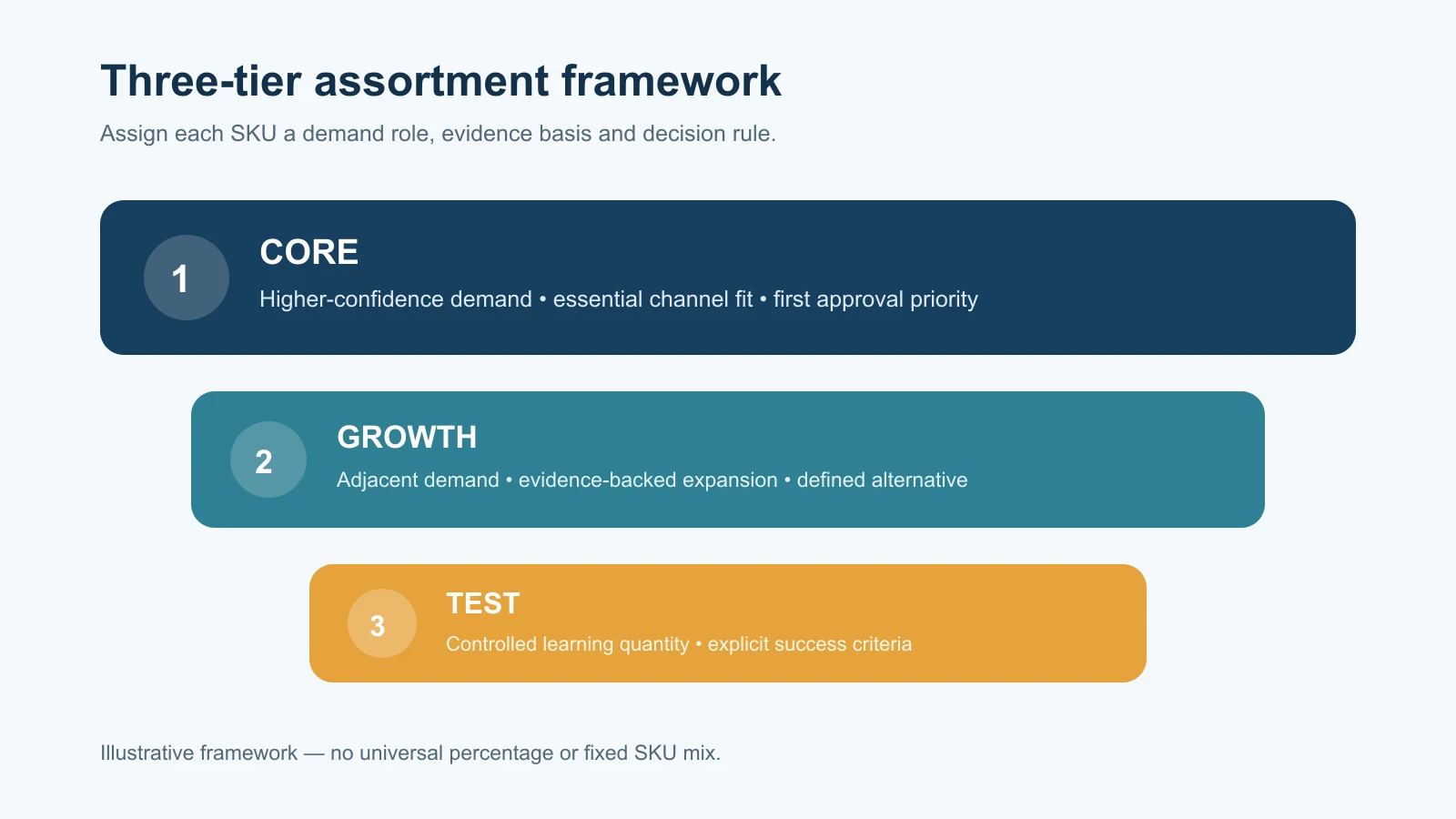
The mix is order-specific. Assign evidence and a decision rule to each tier instead of applying a universal percentage.
- Core: products with higher-confidence demand, essential channel fit or a defined role in the buyer's current assortment.
- Growth: adjacent products supported by customer requests, category data, retailer feedback or a clear expansion thesis.
- Test: controlled learning lines with an explicit reason for inclusion and a method for reviewing results after sale.
Browse the current FMCG product catalogue to form a shortlist, then confirm the exact pack, barcode, case quantity, artwork, date condition and current sourcing status for each selected item. Buyers can also explore the Beverage, Food, Home Care and Personal Care category hubs. Catalogue presence is not a fixed availability commitment.
Give Every SKU a Job
Each SKU should have a role that explains why it deserves space and operational attention. A line might be a traffic builder, basket builder, premium option, impulse item, foodservice format, seasonal test or substitute for a known gap. The labels are planning tools, not performance claims. They should be supported by buyer-side evidence and reviewed for the intended market.
Compare products that appear to serve the same role. Two similar variants may be justified when they address different channels, price bands or customer groups. If no clear distinction exists, keeping both may add case increments, label work and data risk without improving the assortment. Record the decision rather than relying on memory or a broad brand preference.
Create One Master SKU Sheet
The master SKU sheet should be the current source for quotation, load planning, label review and document preparation. Give it a version, date and owner. Avoid parallel spreadsheets that contain slightly different product names or quantities.
| Field group | Minimum information to record | Decision it supports |
|---|---|---|
| Identity | Brand, exact SKU, variant, barcode when verified, category | Prevents pack or artwork ambiguity |
| Pack and order | Retail size, units per case, requested cases, case increment | Defines the quotation basis |
| Carton data | Carton dimensions, gross/net weight and handling notes when confirmed | Supports load review |
| Product controls | Date requirement, storage condition, formula or market-pack distinction | Sets acceptance checks |
| Labels and documents | Artwork language, label status, required document and acceptance criteria | Identifies compliance gates |
| Readiness | Ready, conditional or blocked; owner; evidence date; approved alternative | Makes exceptions actionable |
Unknown information should be marked unknown, not copied from a similar SKU. Barcode, carton, weight, artwork and formula data can change between packs or markets. A field becomes usable only when its source and applicable version are clear.
Check Physical and Handling Compatibility
A commercially attractive assortment may still need adjustment before consolidation. Review heavy cartons against crush-sensitive cartons, liquids against leakage exposure, strongly scented goods against odor-sensitive products, and items with heat, moisture or orientation constraints. Pallet requirements and manual carton handling can also change the practical loading approach.
Do not calculate capacity from generic carton assumptions. Actual loading depends on confirmed carton dimensions and weights, container limits, palletisation, route, product compatibility and the loading method. The warehouse, forwarder and responsible parties should review the current data before a load plan is treated as approved.
Align MOQ, Readiness and Alternatives
Separate each shortlisted line into ready, conditional or blocked status. A ready line has the required commercial and product data for the next decision. A conditional line still needs a named field, approval or sourcing check. A blocked line cannot proceed under the current requirement. Status should be dated because conditions can change.
Identify which SKU or approval controls the wider schedule. One delayed line can affect the proposed shipment when it is necessary to complete the assortment or when other products cannot proceed independently. That does not mean every delay must hold the whole order. The parties should review whether the line can be replaced, deferred or removed without breaking the commercial, label, document or loading plan.
Approve alternatives before an exception occurs. Define the acceptable brand, variant, size, pack, artwork, case increment and price impact—or state that no substitution is allowed. Silence is not approval. The current list, quotation and dependent document data should all reflect the buyer's written decision.
Freeze Data Before Final Documents
Set a freeze point after the assortment, commercial basis and required product checks are approved. The frozen SKU list should carry a version number and identify who may approve later changes. A post-freeze change needs an impact check across quantity, value, carton count, weights, marks, labels, dates and document descriptions.
Reconcile the commercial invoice, packing list, carton marks, transport information and other required drafts against the same approved source. Vietnam Customs research on export-document digitisation highlights the need for seller-issued documents such as the commercial invoice and packing list to remain synchronised. Additional documents may be supported on request depending on the product, manufacturer, destination, issuing authority and shipment; they are not a fixed set for every order.
Use Six Buyer Approval Gates
Approval gates keep decisions in sequence and stop an early shortlist from being mistaken for a released shipment. Each gate should name the evidence reviewed, open exceptions, approver and current version.
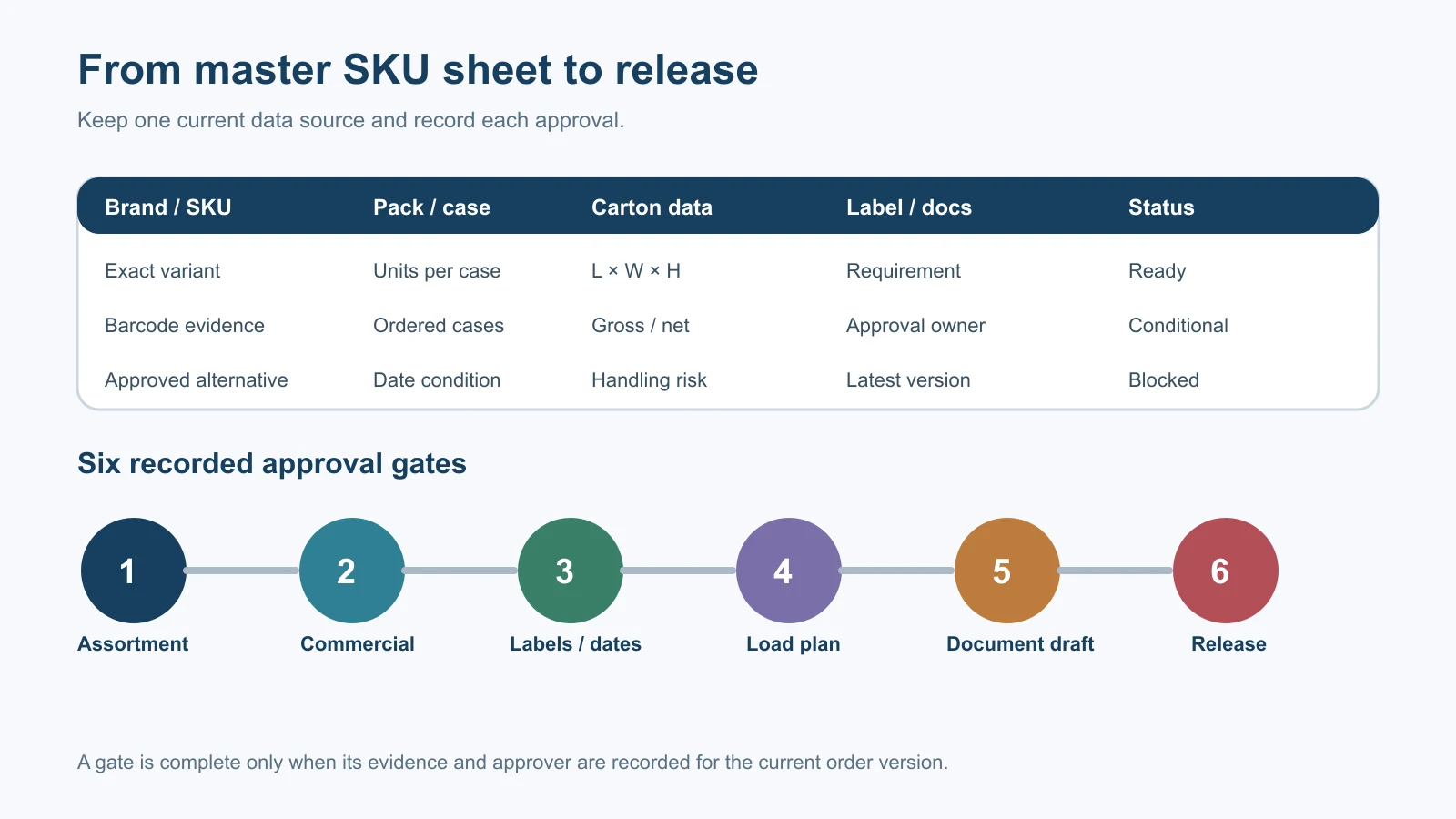
The six gates connect assortment logic to commercial, product, loading and document evidence.
- Assortment gate: every SKU has a tier, role and reason for inclusion.
- Commercial gate: pack basis, quantities, prices, trade term, payment method and validity are recorded.
- Label and date gate: required artwork, label information, lot/date criteria and evidence responsibilities are clear.
- Load-plan gate: confirmed carton data, handling compatibility and open capacity questions are reviewed.
- Document-draft gate: names, quantities, weights, marks and consignee details match the approved source.
- Release gate: exceptions are closed or accepted in writing, and the authorised parties release the current version.
The FMCG Export Services page explains OneDay FMCG's mixed-container and shipment-support scope. Actual product compatibility, document availability, labeling or repacking work and final terms remain subject to the selected products, destination and written order scope.
Frequently Asked Questions
How many brands should be included in one FMCG container?
There is no universal number. The workable mix depends on demand, confirmed case increments, carton data, compatibility, document needs and whether the approved assortment can complete the container. More brands are not automatically better.
How should importers balance core and test SKUs?
Start with buyer-side demand evidence and give each tier a purpose. Core lines support higher-confidence needs, while test lines use controlled quantities and explicit learning criteria. Avoid fixed percentage rules that ignore the market and case data.
Which carton data is needed for load planning?
Confirm dimensions, gross and net weight, units per case, carton orientation or handling limits and pallet requirements where relevant. Use data for the exact SKU and pack; do not infer it from a similar item.
Can one delayed SKU hold the full shipment?
It can affect the wider plan when it is necessary to complete the confirmed assortment or when dependent labels or documents cannot proceed. The parties should review an approved alternative, deferral or removal and record the impact rather than apply a universal rule.
When should the final SKU list be frozen?
Freeze it after the assortment, commercial basis and required product checks are approved but before final document preparation and release. Any later change should be versioned and checked across all dependent data.
Prepare the Sourcing Request
Send the destination, sales channels, category priorities, exact product shortlist, estimated case quantities, carton data already available, label and document needs, proposed timing and acceptable alternatives through the Contact page. OneDay FMCG can then review the request, identify information still requiring confirmation and discuss a case-specific mixed-container plan.
Planning references: ICC Incoterms® 2020 and Vietnam Customs research on digitising export documents.
Category planning references: Start with the FMCG overview, then review Agriculture and Confectionery where those categories fit the market brief. Exact assortment, pack data and shipment feasibility require case-specific confirmation.
Sourcing FMCG from Vietnam?
Tell us what you are looking for and we will come back with a wholesale offer.
RELATED ARTICLES
View All 14 Oct, 2026
Gum, Candy and Cookies: A Three-Format SKU Triage Checklist
 07 Oct, 2026
How to Source Vietnamese Coffee Wholesale: A Buyer Checklist
 25 Sep, 2026