

FMCG MOQ Vietnam: How One Mixed-Container Minimum Works
FMCG MOQ Vietnam enquiries often begin with a simple question: “What is the minimum order?” The useful answer depends on what the minimum measures. It may apply to the total shipment, an individual SKU, a case increment, a production run or a packaging project. OneDay FMCG's standard MOQ is one mixed container. There is no separate fixed minimum per SKU, carton or pallet when the confirmed assortment can complete that container. That does not mean unrestricted quantities or automatic acceptance of every combination. The final mix remains subject to SKU, availability, case increment, handling and shipment review. This guide shows buyers what to clarify before requesting a quotation.
Key takeaways
- Ask which level an MOQ applies to before comparing quotations.
- OneDay FMCG's standard minimum is one mixed container—not LCL, no MOQ or any-quantity ordering.
- Case increments, current packs, sourcing conditions and handling compatibility can still shape each SKU quantity.
- Made-to-order, labeling, repacking, OEM, private-label or custom-pack projects may introduce separate conditions.
- A decision-ready enquiry includes destination, shortlist, estimated cases, pack and date needs, documents and acceptable alternatives.
What Buyers Mean When They Search for “Low MOQ”
“Low MOQ” is a search phrase, not a complete commercial specification. One supplier may use it for a small total shipment, another for a small number of cases per SKU, and a manufacturer may use it for a production run of one formula or artwork. Without the measurement level, two numbers can appear comparable while describing different commitments.
Stocked wholesale goods and made-to-order goods also behave differently. A stocked item may be ordered in existing case increments when it is available and suitable for the shipment. A custom formula, label, pack or production run may depend on materials, setup, artwork approval or manufacturer conditions. Buyers should therefore ask: MOQ measured at which level, for which pack, under which sourcing basis?
OneDay FMCG should not be described as a low-MOQ or LCL supplier. The confirmed standard is one mixed container. The flexibility is at the assortment level: approved products can be combined so the confirmed mix completes the container, subject to the checks explained below.
OneDay FMCG's Standard MOQ
The standard MOQ is one mixed container. There is no separate fixed minimum per SKU, carton or pallet when the confirmed assortment can complete the container. A buyer may therefore propose several product lines rather than filling the container with one item.
This policy is not a promise that any quantity of every catalogue item will be accepted. Each proposed line still needs review against its current retail pack, units per case, case increment, availability or sourcing condition, carton data, date condition and compatibility with the wider load. A practical quantity may also change if the selected pack or case configuration differs from an early catalogue reference.
For the operating stages behind consolidation, read the mixed-container planning guide. That article covers the buyer brief, SKU readiness, load planning and document reconciliation. This page focuses only on how the minimum and related quantity conditions should be understood.
Four MOQ Levels to Clarify Before Quotation
An order can contain more than one minimum or increment. Separating the following levels prevents a shipment-level statement from being mistaken for a product-level promise.
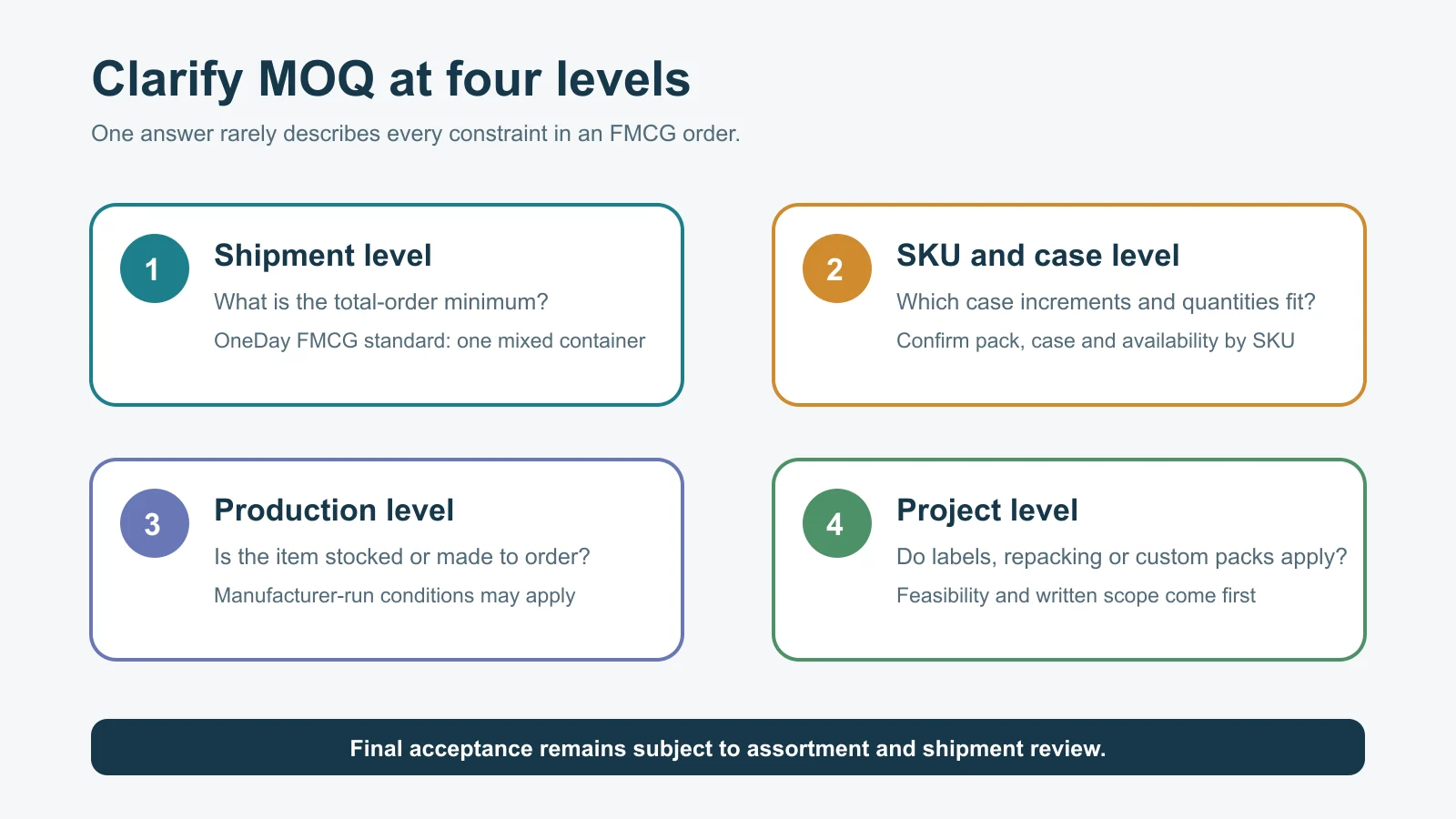
Clarify which level controls each quantity before treating an MOQ as confirmed.
1. Shipment-level minimum
This is the minimum total order basis. For OneDay FMCG, it is one mixed container. The approved assortment must be capable of completing that container under the final loading plan. “Mixed” describes the assortment within a container; it does not change the shipment into an LCL offer.
2. SKU and case increments
Products are normally handled in defined case configurations. A request for an arbitrary unit count may not match how the product is packed or sourced. Confirm the retail size, variant, units per case, requested cases and any case increment for every selected line. These details should come from the current proposed pack, not an old image or previous order assumption.
3. Manufacturer or production-run conditions
A selected product may be available through current wholesale sourcing, or it may require a manufacturer run. Production conditions can differ by product, formula, artwork, material or source. They should be checked for the actual request and recorded in the quotation rather than converted into a universal rule for the catalogue.
4. Project-specific conditions
Labeling and repacking may be available for selected products and projects, subject to feasibility and written scope confirmation before order acceptance. OEM, private-label and custom-packaging enquiries are likewise project-specific. Artwork, packaging materials, setup or production conditions can change the minimum and schedule for that project without changing the standard mixed-container MOQ for ordinary catalogue sourcing.
Build an Assortment That Can Complete the Container
Begin with priority categories and must-have SKUs. Use the current FMCG catalogue to identify candidate products, then record the exact name, variant and pack shown. Catalogue listings support discovery; current specifications and availability must still be confirmed for the proposed order.
Assign an estimated case quantity to each item instead of writing only “mixed products.” This gives the review a starting structure. The proposed mix can then be checked against case increments, carton dimensions, gross weight, sourcing conditions and handling needs. Heavy cartons, heat-sensitive confectionery, liquids and strongly scented household products may require different placement or compatibility decisions.
Mark acceptable alternatives in advance. An alternative is not an automatic substitution: it is a product the buyer permits the team to evaluate if the first choice cannot be confirmed. State which attributes must remain unchanged—such as category, pack range, flavor, artwork language or price ceiling—and require written approval before the order record changes.
A future guide will address detailed multi-brand assortment construction. For an MOQ review, the immediate goal is simpler: show that the shortlist is specific enough to test whether a feasible combination can complete the container.
Check Order Economics Beyond Unit Price
MOQ decisions should not rely on unit price alone. The commercial picture may include product value, inland handling, consolidation work, approved labeling or repacking, documentation, international freight, insurance, destination duties and taxes, clearance and local delivery. Which items are included depends on the quotation, agreed Incoterms® rule and applicable sales documents.
Ask for the Incoterms® rule, named place or port and version to be stated together. OneDay FMCG may discuss EXW, FCA, FOB, CFR and CIF depending on the order and shipment. These rules allocate important delivery tasks, costs and risks; they do not replace the sales contract or define the payment method. L/C and T/T, where agreed, should be documented separately from the delivery term.
Price breaks, quotation validity and quantity assumptions should be explicit. A revised case count or pack may change the commercial result. Avoid treating an indicative unit figure as permanent when the underlying assortment, freight scope or project work is still open.
Questions to Resolve Before Confirming MOQ
| Question | Why it matters | Record in writing |
|---|---|---|
| What level does the MOQ describe? | Separates the total shipment from SKU, production or project conditions | Container basis and any line-specific condition |
| What is the current case configuration? | Prevents unit quantities from conflicting with case increments | Retail pack, units per case and requested cases |
| Is the line currently sourced or made to order? | Changes the evidence and production conditions required | Sourcing basis and confirmation status |
| What date condition is required? | Production, expiry and remaining shelf life can vary by SKU and lot | Buyer requirement and accepted evidence |
| Are labels, repacking or custom packs needed? | May add feasibility, material, artwork and project conditions | Exact scope, owner and approval condition |
| Which substitutions are acceptable? | Prevents an unavailable line from changing silently | Alternative rules and written approval path |
| Which documents are required? | Support depends on product, manufacturer, destination and shipment | Required document, responsible party and acceptance condition |
For product and date controls, review the Product Quality & Shelf Life Policy. C/O, Health Certificate, Certificate of Free Sale, COA or related documents may be supported on request depending on the product, manufacturer, destination, issuing authority and shipment. They are not a fixed set attached to every order.
Information to Send for an MOQ Review
A short but structured buyer brief allows the proposed assortment to be evaluated without inventing missing details. Send the destination country and port, preferred Incoterms® rule, category or SKU shortlist, estimated cases per item, retail pack or artwork needs, date-code requirements, requested documents, target timing and any accepted alternatives.
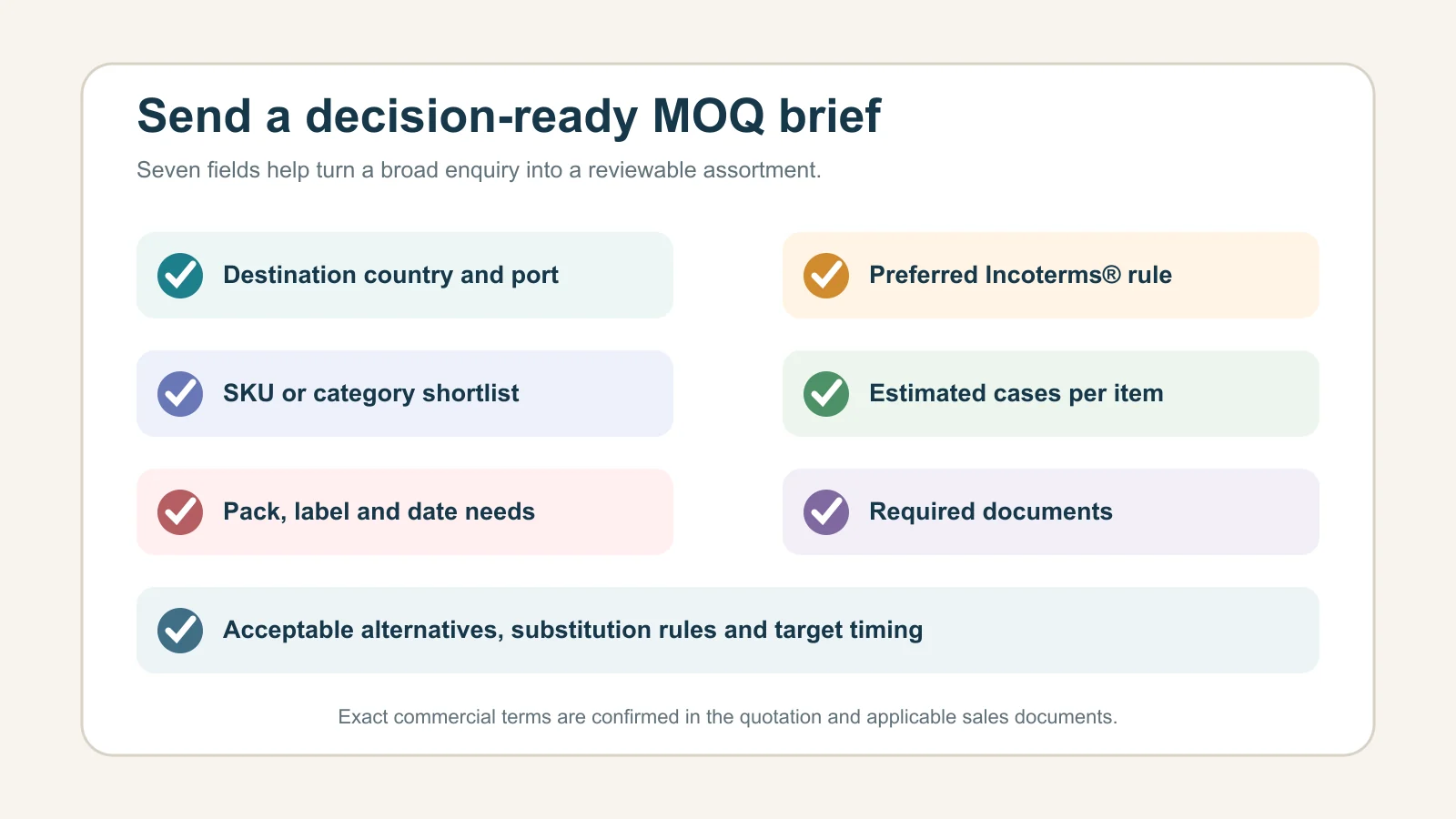
A decision-ready brief identifies both the desired assortment and the conditions that could change it.
If carton measurements or exact case data are not yet known, do not guess. Mark the field for confirmation and identify what decision depends on it. The review can distinguish confirmed information from open items, then return a quotation or clarification list based on the actual sourcing and shipment scope.
The FMCG Export Services page explains the broader consolidation and commercial support scope. When the brief is ready, use the Contact page to send the assortment for review.
Frequently Asked Questions
What is OneDay FMCG's standard MOQ?
The standard MOQ is one mixed container. The confirmed assortment must be able to complete the container and remains subject to SKU, availability, case increment, handling and shipment review.
Is there a separate minimum per SKU, carton or pallet?
There is no separate fixed minimum per SKU, carton or pallet when the confirmed assortment can complete the mixed container. Individual products can still have case increments, sourcing or production conditions that must be confirmed.
Does one mixed-container MOQ mean every product combination is accepted?
No. Product compatibility, current packs, case data, availability, date requirements, labels, documents and the final loading plan must be reviewed for the actual combination.
Can labeling, repacking or private-label work change MOQ requirements?
Yes. Labeling and repacking are available only for selected products and projects, subject to feasibility and written scope confirmation. OEM, private-label or custom packaging may have separate project or production conditions.
What details are needed for an FMCG MOQ review?
Send the destination, preferred Incoterms® rule, SKU or category shortlist, estimated case quantities, pack and date needs, document requirements, acceptable alternatives and target timing.
Request an Assortment and MOQ Review
Send your destination, preferred SKUs, estimated case quantities, pack or label needs, document requirements and target timing so OneDay FMCG can review whether the proposed assortment can complete a mixed container.
Trải nghiệm giải trí: Thư giãn đôi mắt sau ngày dài làm việc trước màn hình máy tính với tính năng nghe audio Hôm Nay Thủ Phụ Đại Nhân Thấy Nóng Ruột Chưa trên Hắc Truyện – thưởng thức trọn vẹn bộ tiểu thuyết cổ đại hấp dẫn với giọng đọc AI mượt mà và liền mạch.
Sourcing FMCG from Vietnam?
Tell us what you are looking for and we will come back with a wholesale offer.
RELATED ARTICLES
View All 14 Oct, 2026
Gum, Candy and Cookies: A Three-Format SKU Triage Checklist
 07 Oct, 2026
How to Source Vietnamese Coffee Wholesale: A Buyer Checklist
 25 Sep, 2026