

FMCG Supplier Due Diligence Checklist for Importers

A due diligence file brings product, commercial and document evidence into one review trail.
FMCG supplier due diligence is not a single document request. It is a risk-control process that helps an importer compare the supplier identity, the exact products, the commercial offer and the shipment record before a purchase decision. The evidence needed will vary with the product, destination market, order value, sales channel and contract structure.
If you are building the review process from the beginning, start with the supplier verification workflow, then use this checklist to record evidence and decisions.
Use this checklist as a working file rather than a pass/fail form. Mark each item as verified, pending or not applicable; give it an owner; and record when it should be checked again. A complete-looking file is not a guarantee of performance. It is a way to make assumptions visible, resolve mismatches early and decide whether to proceed, proceed with conditions or pause the transaction.
How to use this checklist.
Start with the product and destination you actually intend to buy. A document that is relevant to one SKU, factory or market may not apply to another. Keep copies or references to the evidence you reviewed, identify who confirmed it and note the date. Where a requirement is unclear, assign an action instead of treating the box as complete.
For a first review, separate facts from supplier statements. For example, record the legal entity exactly as it appears on its registration evidence, then compare it with the quotation, invoice details, contract party, bank beneficiary and email domain. A registry match can help establish identity; it does not prove product quality, stock availability or future delivery performance.
1. Confirm the company and counterparty
- Record the legal entity name, identifier, registered address and the source checked.
- Check registered status through an official source where one is available, such as the Vietnam National Business Registration Portal for a Vietnam-based entity.
- Reconcile the legal name across the quotation, contract, commercial invoice, bank beneficiary and company email.
- Confirm the authorised commercial contact and an escalation contact through a known channel.
- Document the supplier's role in this transaction: manufacturer, exporter, wholesaler or sourcing partner.
Do not assume that a website name, product logo or email signature proves the contracting party. If several records use different names, ask for the relationship and the invoicing party to be explained in writing. The buyer should know who is responsible for the offer, who can approve changes and who will appear on the sale documents.
2. Build SKU-level product and brand evidence
General catalogue images are a starting point, not a complete product record. Create one line for every intended SKU and capture the current product name, unit size, case count, carton dimensions, gross/net weight, barcode where applicable, pack images and label version. Record the source and date because packaging and assortment details can change.
Ask for the evidence needed for your category: specification, ingredient or allergen information, storage instructions, date-coding format and current pack photography. Where a brand relationship or distribution right matters to the purchase, ask how it is evidenced for that product and market. Do not infer authorisation merely because a brand appears in a catalogue.
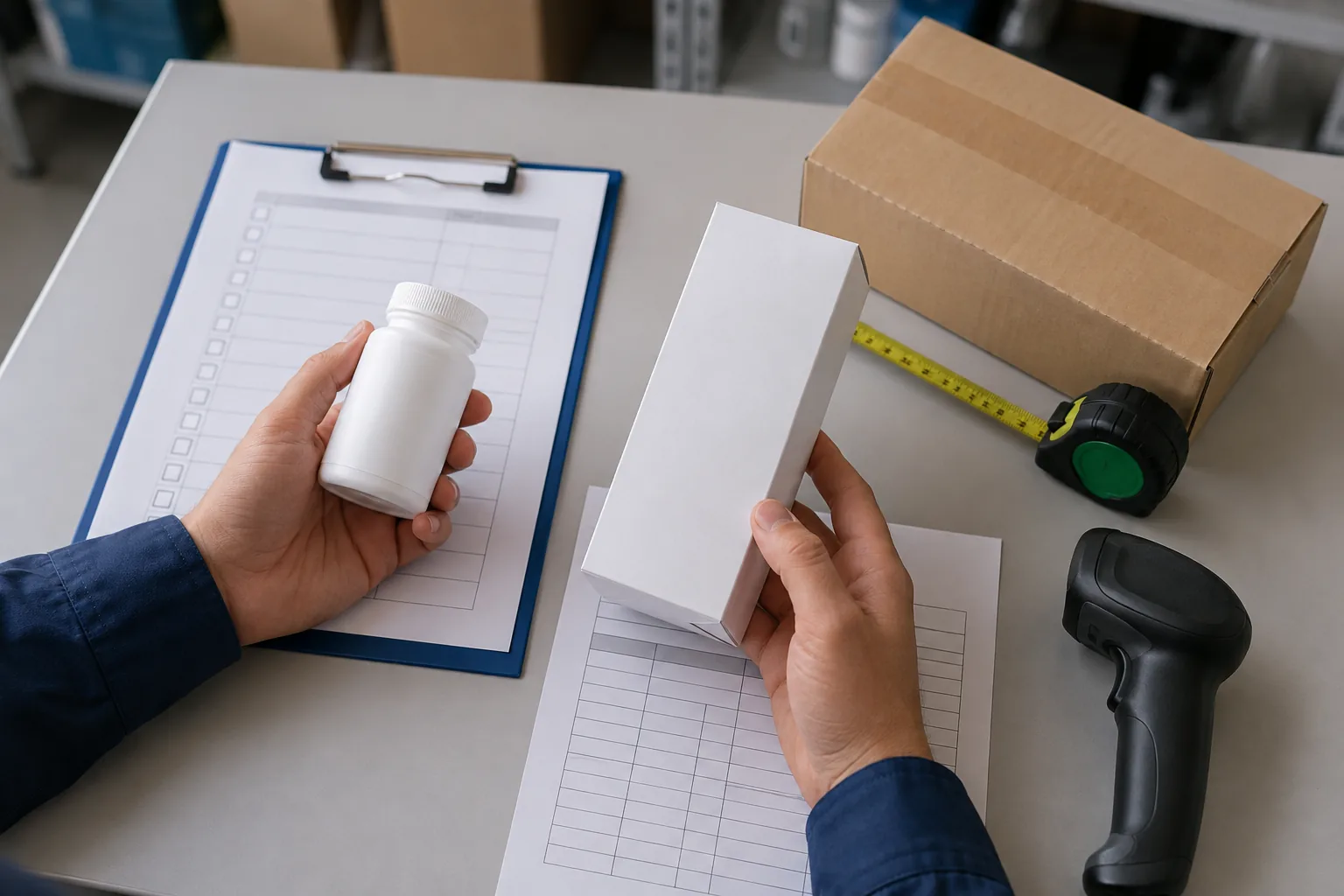
SKU-level packaging and measurement checks help prevent a generic product description from becoming an order assumption.
Certificates and test reports should also be treated as specific evidence. Check the holder, issuer, scope, product or site reference and validity date. A certificate may be relevant to a factory, product or project, but it should not be used as a blanket approval of every item in an order.
3. Record quality, shelf-life and destination-market controls
For date-sensitive FMCG, record the stated total shelf life for each SKU and agree the required remaining shelf life at dispatch in writing. Clarify how production dates or lot information will be confirmed, who approves a variance, and what inspection, non-conformance or claim process applies. Temperature or special-handling needs should be captured if the product requires them.
The importer is responsible for confirming destination-market product and label requirements with the appropriate local adviser, authority or customer. Document the required language, mandatory fields, restricted claims, ingredient restrictions and relevant pack-format rules. If supplementary labels are considered, record who approves the wording, placement and timing before an order is accepted; do not assume that every label service is available for every SKU or project.
4. Make commercial terms comparable
A quotation should be detailed enough for the buyer to compare like with like. Record the currency, price basis, quote validity, inclusions, exclusions and the version reviewed. Capture the minimum-order basis exactly as it is offered—by SKU, case, brand, category or total order—rather than converting it into a claim that may not apply to the proposed assortment.
Write the agreed Incoterm, version and named place or port into the offer. Incoterms® rules allocate defined obligations, costs and risk between seller and buyer; they do not by themselves settle payment, ownership, product conformity or destination-market compliance. The ICC Incoterms® 2020 guidance is useful for checking the selected rule. Keep payment milestones and beneficiary verification as a separate part of the file.
- Record the payment schedule, permitted payment method and beneficiary-verification step.
- Document who can approve substitutions, price changes or changes to the SKU list.
- Retain the quotation version that supports the purchase decision.
- Escalate a late bank-detail change through a known contact, not only by reply email.
5. Prepare shipment and document checks
Agree early which commercial and transport-document fields need to match: product descriptions, marks, quantities, weights, dates and consignee information. Assign one person to review the draft documents and set a deadline before shipment. This reduces the risk of discovering an inconsistency after documents have already been issued.
Some certificates or supporting documents may be required for a specific product, factory, destination market or shipment. Identify those requirements before shipment and confirm their availability for the actual order. For context on documentary preparation, see OneDay FMCG's export compliance and documentation guide; destination requirements still need confirmation for the buyer's own market and transaction.
6. Use security controls and a decision record
Supplier due diligence also needs basic fraud controls. Keep sensitive documents in controlled storage, confirm new email domains and urgent payment changes through a known phone or contact path, and make sure the final beneficiary matches the agreed contracting structure. These controls do not accuse a supplier of wrongdoing; they make a high-impact change visible to the right person.
Use the following evidence table as the core record. Add rows for each SKU, document or commercial issue that needs a separate decision. The status should describe the evidence, not a vague confidence score.
| Item | Evidence | Status | Owner | Review / expiry date | Notes |
|---|---|---|---|---|---|
| Legal entity | Official registry record matched to quotation | Verified / pending / N/A | Procurement | Enter date | Record any name difference |
| SKU and pack | Current pack image, specification and case details | Verified / pending / N/A | Product owner | Enter date | One row per SKU where needed |
| Destination readiness | Buyer-confirmed label and product requirements | Verified / pending / N/A | Compliance | Enter date | State the market and adviser/source |
| Commercial offer | Approved quotation version and named Incoterm place | Verified / pending / N/A | Procurement | Quote-validity date | Keep payment terms separate |
| Shipment documents | Required fields and document-review owner | Verified / pending / N/A | Logistics | Pre-shipment deadline | List conditional certificates separately |

Separate verified evidence, conditions to resolve and unresolved issues before approving the next step.
At the end of the review, choose one of three outcomes. Proceed means the required evidence is sufficiently reconciled for the next agreed step. Proceed with conditions means the remaining items, owner and deadline are written down before exposure increases. Stop pending resolution means a material inconsistency, missing evidence or unapproved change requires clarification. None of these outcomes is a guarantee; they create an auditable reason for the decision.
Questions buyers often ask
What is FMCG supplier due diligence?
It is a documented review of the supplier, the specific products, commercial terms, destination requirements and transaction controls before a buyer commits to an order. It helps teams compare evidence and follow up on gaps.
Which supplier documents should be checked first?
Start with the legal counterparty evidence and the current quotation, then verify the exact SKU and pack information for the intended order. Document requirements should be identified for the product and destination rather than assumed from a generic list.
How often should supplier evidence be refreshed?
Refresh evidence when the product, supplier role, factory, destination market, quotation, label or transaction structure changes. Track the document validity date and set a review date for information that can expire or be replaced.
Is a certificate enough to approve an FMCG supplier?
No. Check the holder, scope, issuer, product or site reference and validity, then combine it with company, product, commercial and shipment evidence. A certificate by itself does not resolve every order risk.
Who confirms destination-market requirements?
The importer should confirm applicable requirements with the relevant local authority, adviser or customer. The supplier can review a defined request, but the buyer should not treat a general document list as destination-specific advice.
Prepare a better sourcing brief
Use this checklist to assemble the facts before asking for a quotation: destination market, category or SKU list, quantities, delivery window, labeling needs and document requirements. Then contact OneDay FMCG with the information available for a case-specific review. You can also review the site's policies before beginning the discussion.
Sourcing FMCG from Vietnam?
Tell us what you are looking for and we will come back with a wholesale offer.
RELATED ARTICLES
View All 14 Oct, 2026
Gum, Candy and Cookies: A Three-Format SKU Triage Checklist
 07 Oct, 2026
How to Source Vietnamese Coffee Wholesale: A Buyer Checklist
 25 Sep, 2026