

How to Verify a Reliable FMCG Supplier in Vietnam
By OneDay FMCG Editorial Team | Published September 7, 2026 | 9-minute read
Choosing an FMCG supplier is not only a product-search exercise. Importers need to establish the counterparty, its operating role, the evidence supporting each product, and whether commercial and shipment details agree before committing funds or inventory.
The objective is not to find a supplier that makes the strongest claims. It is to build a reviewable evidence trail. A reliable first-pass process moves from company identity to operating role, SKU-level information, commercial clarity, export readiness, communication discipline, and a controlled first transaction.
No single document completes that process. Registration information does not independently prove product quality, stock, authorization, export experience, or future performance. Other evidence must also match the relevant company, product, site, date, market, and transaction.
Key takeaways
- Match the supplier's legal identity across registry information, quotations, invoices, bank beneficiary details, website, and business email.
- Confirm whether the company acts as manufacturer, exporter, wholesaler, sourcing company, or a combination of roles.
- Review evidence at SKU level instead of relying on broad statements about quality or export readiness.
- Put product, commercial, labeling, document, and shipment assumptions into one written record.
- Use samples and a controlled first order as additional evidence, not as a guarantee of future performance.
- Treat repeated inconsistencies or refusal to provide basic evidence as more significant than one minor administrative error.
Why supplier verification matters in FMCG sourcing
FMCG orders combine fast-moving inventory with details that can change by SKU and production lot. Pack size, carton configuration, date coding, artwork, ingredients, storage instructions, certificates, and remaining shelf life may differ across products that appear similar in a catalogue.
An importer also has destination-specific responsibilities. A product sold in Vietnam is not automatically ready for another market. Label language, importer information, claims, composition rules, product registration, testing, and certificates may depend on the destination and product type. A supplier can help assemble information, but the buyer should confirm local import and sale requirements with the relevant authority, customs broker, or qualified adviser.
Verification therefore has two purposes. First, it tests whether the counterparty and its claims are consistent. Second, it identifies gaps early enough to resolve them before payment, labeling work, production, consolidation, or dispatch.
Step 1 — Confirm the company identity
Start with the legal entity that will issue the quotation and invoice. Ask for the company’s legal name, enterprise or tax identifier, registered address, and the name and role of the representative handling the transaction.
Vietnam’s National Business Registration Portal provides access to business-registration information and related services. Use it as a starting point, then compare the retrieved identity information with the supplier’s quotation, contract, invoice, website, email domain, and proposed bank beneficiary.
Minor formatting differences can occur, especially in English translations or abbreviated addresses. They should still be explained. A different legal name, unrelated beneficiary, unexplained address, or last-minute account change deserves further review before payment.
Keep the conclusion narrow: a registry match supports the existence and identity of the registered enterprise. It does not certify that a particular employee is authorized, that a product is genuine, that a certificate is valid, or that an order will be executed correctly.
Step 2 — Verify the supplier’s operating role
“Supplier” can describe several different business models. The company may manufacture goods, export products made by other factories, distribute branded stock, consolidate orders from multiple sources, or coordinate sourcing and documentation.
Ask which party will:
- issue the commercial invoice and receive payment;
- control or confirm stock and production availability;
- obtain product specifications and lot information;
- approve substitutions or packaging changes;
- coordinate labels, certificates, inspections, and shipment documents;
- handle claims or corrective actions after delivery.
There is no universal best model. A wholesaler or sourcing company may be useful for a multi-brand order, while a manufacturer may offer more direct control over one product line. Reliability depends on whether the operating role is disclosed and supported, and whether responsibilities are clear for the proposed order.
When brand or distribution authorization matters, request evidence relevant to the named products, territory, transaction, and date. Do not assume that a company’s access to product photos or samples proves authorization for every market.
Step 3 — Request SKU-level product evidence

Use a staged evidence review before an order is approved.
A general catalogue is useful for discovery but is not enough for an order decision. Build a shortlist and request information for each proposed SKU:
- exact product name and identifying code, when available;
- unit size and packaging type;
- units per carton and carton dimensions or weight;
- label photos or approved artwork;
- ingredient, allergen, nutrition, storage, and date-code information where applicable;
- stated shelf life and expected remaining shelf life for the proposed lot;
- specification, test report, certificate, or authorization when relevant.
Check whether the product name, pack size, manufacturer, and dates agree across photos, specifications, certificates, and the quotation. A document may be authentic but irrelevant if it covers another product, factory, legal entity, or validity period.
OneDayFMCG’s product quality and shelf-life policy explains the importance of confirming quality and date information against the actual product and order conditions.
Step 4 — Test commercial transparency
A useful quotation should allow both parties to understand what is included and what remains conditional. At minimum, align the currency, unit of sale, carton configuration, quantity basis, quotation validity, payment milestones, delivery term, named place or port, and major exclusions.
Avoid treating a three-letter trade term as a complete commercial agreement. The ICC explains that Incoterms® 2020 rules allocate specified obligations, costs, and delivery risks between seller and buyer. The chosen rule should be paired with a precise named place or port. Payment method, product specifications, ownership, quality remedies, and every compliance obligation still need separate agreement where applicable.
Ask how MOQ is calculated: by SKU, carton, brand, factory, or total order. Treat MOQ, price, and lead time as quotation-specific information, not permanent website promises. Availability and production timing should be reconfirmed before order acceptance.
For a broader view of sourcing, consolidation, and shipment support, review OneDayFMCG’s FMCG export services.
Step 5 — Check export and destination readiness
Separate common shipment documents from documents that depend on the product, route, contract, or destination. A commercial invoice, packing list, and transport document are common, but origin, health, analysis, inspection, fumigation, free-sale, or other certificates may be conditional.
Before confirming an order, create a written document list and identify who prepares, reviews, approves, and pays for each item. Product descriptions, quantities, carton counts, marks, dates, consignee information, and origin statements should be consistent across the final set.
Ask for sample document formats when appropriate, but do not confuse a template with a document issued for the actual shipment. The buyer remains responsible for confirming destination-market requirements and should do so before labels or shipment arrangements become difficult to change.
Step 6 — Evaluate communication and change control
Fast replies are helpful, but response quality matters more than speed alone. A reliable supplier should be able to distinguish confirmed facts from estimates, state what evidence is still pending, and record decisions in writing.
During the review, note how the supplier handles:
- missing or conflicting product information;
- changes to pack size, artwork, price, or availability;
- requests for substitutions;
- document corrections and version control;
- escalation when a deadline or requirement may not be met.
Important changes should identify the affected SKU or document, the operational impact, the person responsible, the decision needed from the buyer, and the next update. This is particularly important for mixed-brand orders, where one delayed or changed line can affect consolidation and documentation.
The company’s About Us page can provide context, but transaction-specific written evidence should control the buying decision.
Step 7 — Use a controlled first transaction
Once the main checks are consistent, reduce uncertainty through proportionate exposure. Depending on the product and market, this may include samples, an approved SKU list, packaging or artwork approval, agreed inspection points, a staged payment structure, or a first order limited to a manageable scope.
There is no universal first-order quantity. A sensible scope depends on MOQ, freight economics, shelf life, product value, testing needs, and the buyer’s ability to sell and monitor the goods. The purpose is to create observable checkpoints, not to imply that a small order is risk-free.
Before payment or dispatch, preserve the approved quotation, specification, label version, document list, bank confirmation, and communication record. After delivery, compare the actual product and documents with those approvals. The result becomes evidence for the next order.
Supplier verification red flags
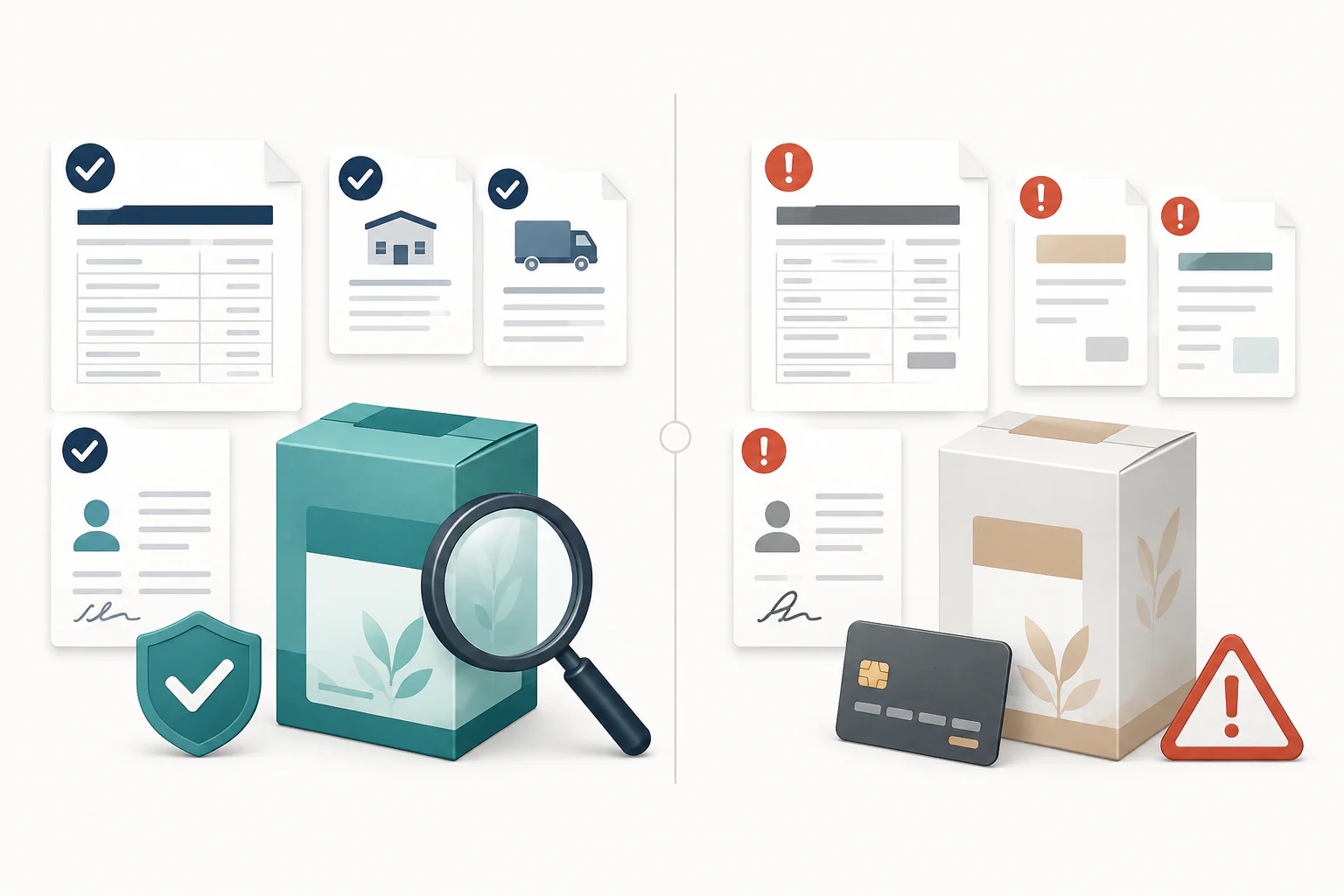
Several unresolved inconsistencies deserve a documented review.
One anomaly may have an ordinary explanation. Several unresolved anomalies should change the risk decision. Examples include:
- company, invoice, contract, and bank-beneficiary names that cannot be reconciled;
- pressure to pay before basic entity or SKU information is supplied;
- refusal to provide product-specific evidence while making broad certification claims;
- certificates with an unrelated holder, site, product, scope, or date;
- frequent unexplained changes to product, pack, price, beneficiary, or shipment details;
- a request to hide, relabel, or describe goods inaccurately;
- answers that remain vague after the buyer identifies a specific decision or document gap.
Do not rely on intuition alone. Record the inconsistency, request clarification, set a decision deadline, and decide whether the evidence resolves the issue. If a legal, sanctions, food-safety, trademark, or regulatory concern remains, obtain appropriate professional advice before proceeding.
Frequently asked questions
How can I verify whether a Vietnam FMCG supplier is a registered business?
Search the legal name or enterprise identifier through Vietnam’s National Business Registration Portal, then compare the result with the quotation, invoice, contract, registered address, representative information, website, email domain, and bank beneficiary. Investigate material differences before payment.
Does business registration prove that a supplier is reliable?
No. Registration supports a legal-identity check. It does not independently prove product quality, authorization, stock, export capability, certificate validity, financial condition, or future order performance. Those areas require separate evidence.
What product evidence should an FMCG importer request?
Request evidence for each proposed SKU: product identity, unit and carton configuration, label or artwork, specification, date coding, shelf-life information, storage details, and any certificate or test report relevant to that product and market. Confirm that names, sites, dates, and scope match.
How can a buyer check whether payment details are consistent?
Compare the beneficiary name and bank details with the contracting and invoicing entity. Confirm any difference or account change through a previously verified contact channel. Do not rely only on a new email containing revised payment instructions.
Should a first order always be small?
Not necessarily. The appropriate scope depends on MOQ, freight economics, product value, shelf life, testing needs, and the buyer’s risk controls. The goal is a manageable, documented transaction with clear approval and inspection checkpoints.
Build a reviewable supplier-verification file
A strong supplier review is a sequence of reconciled facts, not a single certificate or sales claim. Confirm the entity, define the operating role, collect SKU-level evidence, align commercial and destination requirements, observe communication discipline, and preserve the approved record for the first transaction.
To discuss a sourcing request, send OneDayFMCG your destination, target products or categories, estimated quantities, preferred pack sizes, label needs, required documents, and target timing. The team can review the request and identify what information still needs confirmation.
For the next review step, use the FMCG supplier due diligence checklist to record company, product, commercial, shipment and payment evidence in one decision file.
Sourcing FMCG from Vietnam?
Tell us what you are looking for and we will come back with a wholesale offer.
RELATED ARTICLES
View All 14 Oct, 2026
Gum, Candy and Cookies: A Three-Format SKU Triage Checklist
 07 Oct, 2026
How to Source Vietnamese Coffee Wholesale: A Buyer Checklist
 25 Sep, 2026