
Instant Noodle Importer Pack, Date and Label Checklist
By OneDay FMCG Editorial Team · Updated 21 October 2026 · 6-minute read
An instant noodle catalogue page helps an importer find candidates. It does not prove that the exact flavour, retail presentation, case configuration or shipment lot is ready to buy. Before requesting a quote, build one evidence row for each candidate and keep the source of every field visible. This guide explains how to decide whether to shortlist a row, ask for a current document or put it on hold. It does not publish an unverified SKU specification or promise availability.
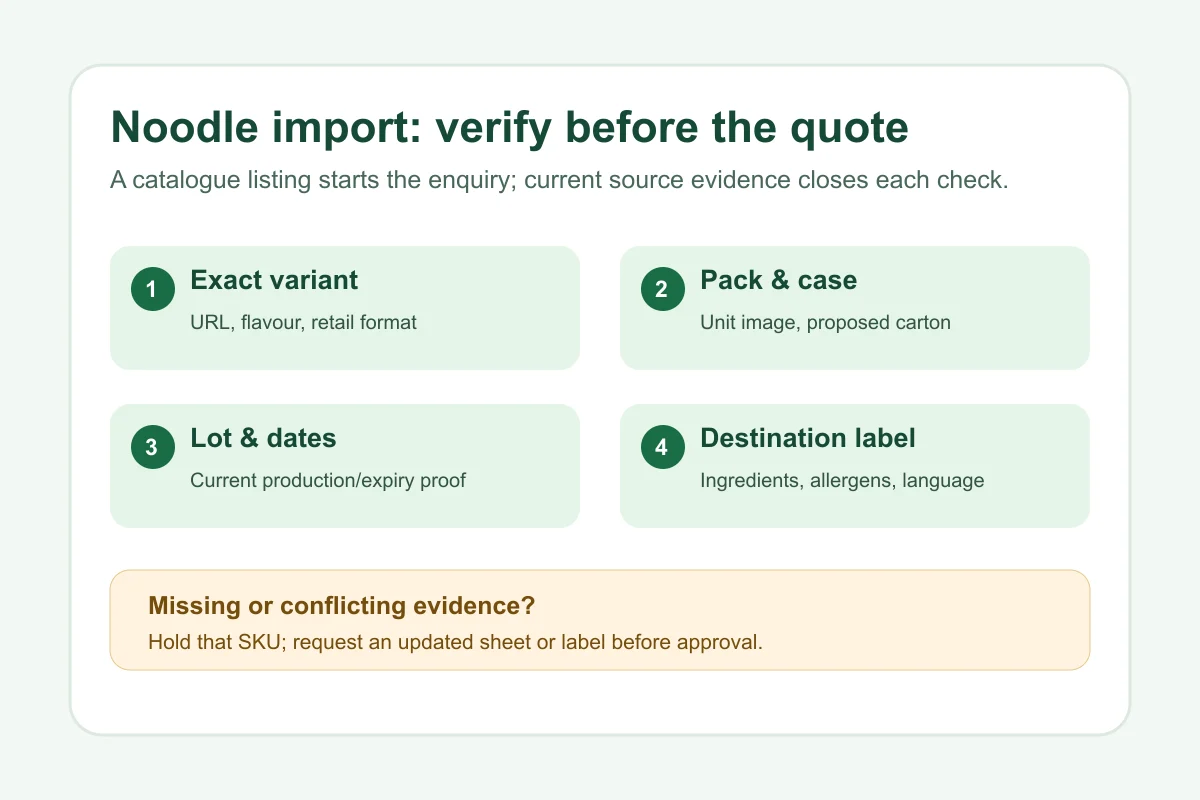
Close each evidence gap for the exact proposed SKU; do not copy a neighbouring variant's details.
1. Identify the exact variant before comparing offers
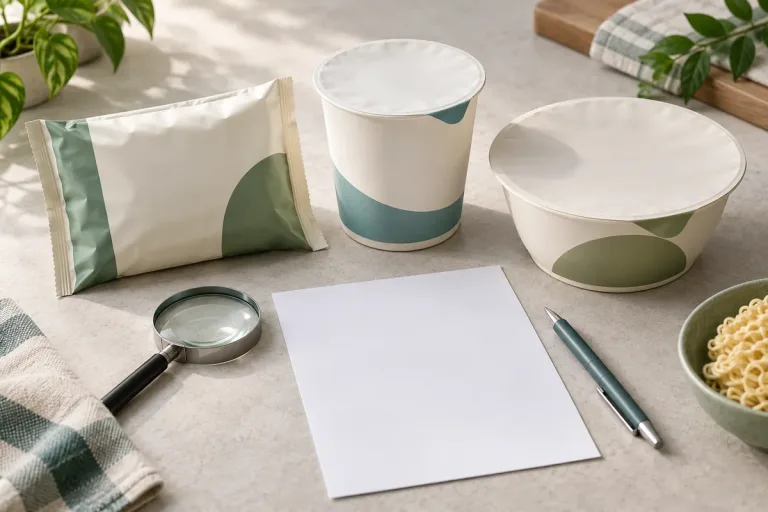
Start with the product URL, displayed name and the presentation the buyer actually wants: for example, a bag, cup or bowl. Record the flavour and any variant identifier supplied by the source. A similar brand name does not make two formats interchangeable. The Noodle catalogue is a starting point for collecting candidate links, while the broader Food catalogue shows where the category sits in the range. Neither page is a current supplier sheet.
If a listing title and the latest source material describe different formats or flavours, stop that row. Ask for a current unit image and source sheet tied to the precise candidate. Do not resolve the conflict by choosing whichever wording appears more often on the website. Mark a catalogue URL as a reference, not as proof of the pack size, ingredients, country of origin, stock or manufacturing relationship.
2. Separate retail-unit evidence from the proposed case
Two quantities can be confused in a fast quotation: what is inside the consumer unit, and how many units are in the shipping case. Request the current front and back retail-pack images and a source record for the proposed case configuration. Write these in separate columns. If an offer includes a pallet or mixed-container proposal, keep that configuration separate too; it should not silently become a standard quantity for every noodle candidate.
Use the same source version for product name, unit image and case description. If the case count, net quantity or presentation differs between an old listing and a current sheet, mark the row request details. Do not derive a case count from a page slug, photograph or another variant. A buyer can still compare possible formats at this stage without presenting uncertain numbers as settled product facts.
3. Agree on date and lot evidence for the actual shipment
Ask which production and expiry date markings will appear on the proposed goods and how the lot or batch can be traced. A general product page cannot establish the dates of a future shipment. The buyer and seller should agree on a remaining-shelf-life acceptance rule for the specific order, then verify it against the actual lot evidence before release. Do not assume one universal threshold or use a historical sample date as if it applies to current stock.
If date format, location of the mark or lot identification is unclear, request a legible current example and document the open question. Keep the row on hold if the proposed lot cannot be matched to the acceptance rule. The site's Product Quality & Shelf-Life Policy explains the order-specific approach; it is not a certificate for any listed noodle SKU.
4. Review label and documents for the destination
Send the current ingredient and allergen panel, preparation directions, retail label images and proposed destination market to the importing party responsible for the local review. They should confirm the applicable language, declaration and presentation requirements before the offer is treated as market-ready. Do not infer that a label suitable in one country is suitable in another, or that a catalogue photograph shows the final export presentation.
Document requests depend on the exact SKU, manufacturer, lot, destination and shipment. Use the Export Compliance & Documentation page to frame the conversation, then agree the required evidence with the responsible partners. A document's availability must be confirmed for the specific transaction. Do not treat a generic list as a promise that every certificate, relabelling service or destination approval is available.
Use a visible stop/go sheet for each candidate
| Field | Evidence to attach | Decision if missing or conflicting |
|---|---|---|
| Exact candidate | Catalogue URL, current source name and variant identifier | Hold until the same item can be matched across records |
| Unit and case | Current unit images plus proposed case sheet | Request details; do not copy figures from a different variant |
| Lot and dates | Proposed lot/date evidence and agreed acceptance rule | Hold shipment approval until the actual lot is checked |
| Destination label | Current ingredient/allergen panel and importer review | Hold market-readiness claim until destination review closes |
Shortlist means the candidate is clear enough for further source checks, not that it is approved or in stock. Request details means a specific source item is still missing. Hold means a conflict or destination question must be resolved before that row advances. Store the document date and owner beside each decision so that a later revision does not inherit an obsolete approval.
Send a quote request that can be checked
A useful RFQ states the candidate URL and exact variant, requested retail format, proposed case configuration, destination and sales channel, desired label language, target delivery window and the outstanding evidence questions. Ask the supplier to confirm current availability, price and lead time for that defined order rather than relying on catalogue text. If several products are combined, confirm the assortment against the standard mixed-container order basis; do not infer a separate minimum for every SKU from this guide.
For a sample decision, imagine a buyer has a cup-format listing but only an older bag-format label. The right next step is not to copy the bag ingredients or date image into the cup row. Attach the cup URL, mark the label and case fields as missing, and request current cup-format source evidence. If the importer has not yet cleared the destination label, leave market readiness open even if the pack information is complete.
When the row is sufficiently defined, use the Contact page to send the candidate list and questions. OneDay FMCG can review a scoped enquiry; any SKU specification, document set and commercial terms remain subject to confirmation for the actual transaction.
Sourcing FMCG from Vietnam?
Tell us what you are looking for and we will come back with a wholesale offer.
RELATED ARTICLES
View All 14 Oct, 2026
Gum, Candy and Cookies: A Three-Format SKU Triage Checklist
 07 Oct, 2026
How to Source Vietnamese Coffee Wholesale: A Buyer Checklist
 25 Sep, 2026