

What Makes a Vietnam FMCG Exporter Reliable for Repeat Orders?
Choosing a Vietnam FMCG exporter for recurring business requires a different test from approving a first order. Initial checks can confirm that a company, product and quotation appear credible. Repeat-order evaluation asks whether the same information remains controlled when packs change, availability shifts, new lots arrive or an exception affects the shipment. Importers and distributors should therefore assess the process behind each cycle: how SKU data is recorded, how changes are approved, how date codes and documents are reconciled, and how unresolved issues are carried into the next order. This framework helps buyers turn those observations into a practical repeat-order review rather than relying on a broad promise of reliability.
Key takeaways
- Use the confirmed product and pack record from each order as the baseline for the next cycle.
- Separate quoted, available, reserved and finally confirmed quantities.
- Require written approval before any SKU, pack, quantity or document assumption changes.
- Track milestones and exceptions by impact, owner, decision deadline and next update.
- Score evidence after each order; do not treat one successful shipment as a permanent guarantee.
Reliability Means Repeatable Execution
A reliable repeat-order process produces an agreed set of outputs through steps the buyer can see and verify. Those outputs may include a confirmed SKU list, case quantities, date-code conditions, approved changes, document drafts and final shipment records. Reliability does not mean that every item will always be available or that every order will follow the same calendar. It means changes and exceptions are identified early enough for a documented decision.
One successful trial order is useful evidence, but it is not enough to predict every later cycle. A new production lot may use different artwork. A requested quantity may no longer match a case increment. A destination requirement or shipping plan may change. Buyers should compare the actual record across several orders and ask whether the process remains understandable when conditions are different.
For initial company and evidence checks, use the earlier guides on verifying an FMCG supplier and the supplier due-diligence checklist. The controls below begin after that onboarding work.
Keep Product, Availability and Lot Data Controlled
Use a stable record, not a stable-supply promise
Create one product record for each requested SKU and market pack. Record the product name, variant, retail size, EAN or barcode when verified, units per carton, artwork language and any formula or handling distinction relevant to the order. Attach a date or version to the record. When a field changes, preserve the previous value and record what replaced it, why it changed and who approved the update.
The current FMCG product catalogue can support discovery, but a catalogue title or image is not a fixed specification. The physical pack, current product evidence and written order confirmation should control the transaction.
Separate availability stages
“Available” can describe several different states. An item may appear in a catalogue, be included in a quotation, be reported as available for sourcing, be reserved for an order or be physically confirmed for loading. A repeat-order file should name the stage instead of using one ambiguous availability label. If a line changes, the update should identify the affected quantity and any impact on price, timing, documents or the rest of the assortment.
This distinction prevents a buyer from treating a preliminary list as a stock commitment. It also makes alternatives easier to evaluate because the commercial and operational consequences are visible before approval.
Confirm lot and date-code conditions for every cycle
Production dates, expiry dates and remaining shelf life can vary by SKU and lot. Buyers should define the date information they need and the point at which it must be evidenced. A repeat-order record may include clear pack or carton photographs, a lot list or another order-specific confirmation. The acceptable condition belongs in the quotation, purchase order or applicable agreement; it should not be inferred from a previous shipment.
Manage Substitutions Through Written Approval
A substitution is not limited to replacing one brand with another. It can involve a different flavor, size, barcode, market pack, case quantity, artwork language or formula. Even a change that appears minor can affect pricing, labeling, product registration, customer expectations or document descriptions.
Define the substitution rule before an exception occurs. The exporter should identify the proposed replacement and explain the differences. The buyer should accept or reject it in writing, and the approved change should flow into the SKU list, quotation, packing information and document drafts. Silence should not be treated as approval. If no replacement is accepted, the order record should state whether the line is removed, deferred or handled under another agreed option.
Reconcile Documents Against the Approved Order
Document control begins with consistent source data. Product descriptions, quantities, weights, carton marks, consignee details and dates should match the approved commercial record. Drafts should be compared against the latest order version rather than an old template or email attachment. A simple document matrix can show the document name, responsible party, source data, draft-review status and final version.
C/O, Health Certificate, Certificate of Free Sale, COA or related documents may be supported on request, depending on the product, manufacturer, destination, issuing authority and shipment. Buyers should identify the required document and acceptance criteria early; no certificate should be assumed available for every item. Review the site's Shipping & Delivery information as a starting point, while keeping the specific quotation and agreement as the controlling record.
Use Milestones and Exception Reports
A repeat order is easier to manage when both parties use the same milestone language. The sequence below is illustrative rather than a promised timeline. The exact steps, dates and responsibilities depend on the products, destination and confirmed shipment.
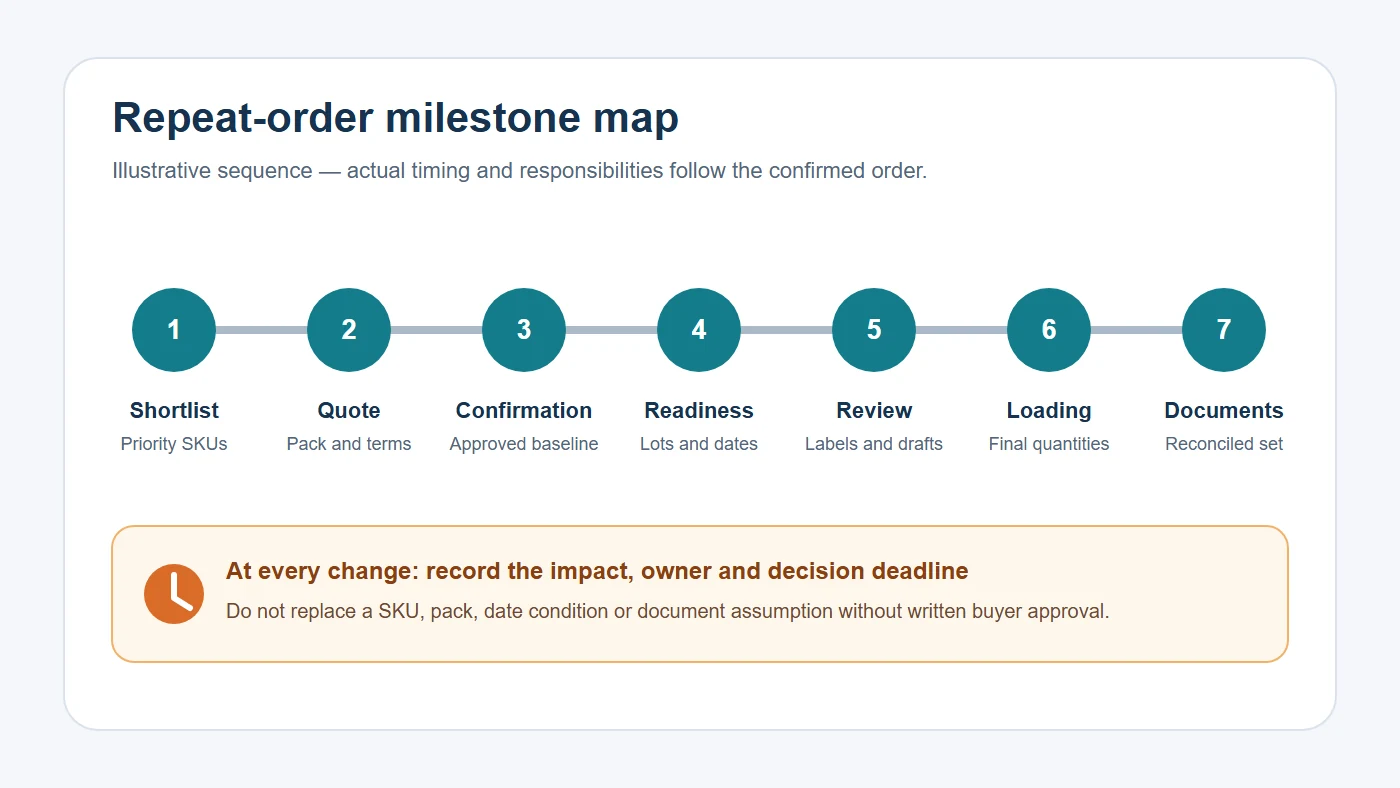
An agreed milestone map makes changes and decision points visible across the order cycle.
| Milestone | Evidence to record | Exception question |
|---|---|---|
| Shortlist | Priority SKUs, destination and requested quantities | Which items or fields are still incomplete? |
| Quotation | Pack basis, case quantity, price basis and validity | What assumptions could change the quote? |
| Confirmation | Approved SKU list, terms and buyer decisions | Is every change reflected in one current version? |
| Readiness | Order-specific availability, lot and date evidence | Which line could affect the wider assortment? |
| Label/document review | Approved artwork needs and reconciled drafts | What still needs buyer or authority review? |
| Loading | Final quantities, cartons and recorded variances | Do actual quantities match the document source? |
| Final documents | Issued versions and shipment reference | Are all final files consistent with the shipment? |
When a milestone changes, an exception update should state the fact, impact, owner, decision deadline and next scheduled update. Avoid vague messages such as “delayed” when the affected SKU, quantity and required decision can be named. The FMCG export services overview provides broader process context; actual scope must still be confirmed for the order.
Close Issues With Evidence and a Prevention Step
Issue handling should begin by preserving evidence: photographs, carton or pack details, lot references, documents and a concise chronology. Next, define the difference between the agreed condition and the observed result. The parties can then review cause, impact and the remedy available under the applicable commercial terms.
Do not assume that every claim automatically results in replacement, credit or refund. The quotation, Proforma Invoice, sales agreement and relevant policy control the outcome. Regardless of the remedy, a useful closure record identifies one prevention step for the next cycle—for example, an added photo checkpoint, a revised field in the product record or an earlier document review.
Use a Repeat-Order Scorecard
A qualitative scorecard helps a buyer compare evidence across cycles without turning the assessment into a guarantee. Rate each control as “needs attention,” “controlled” or “repeatable,” and attach a short evidence note. A high rating should mean the process was demonstrated consistently, not simply that the buyer felt confident.
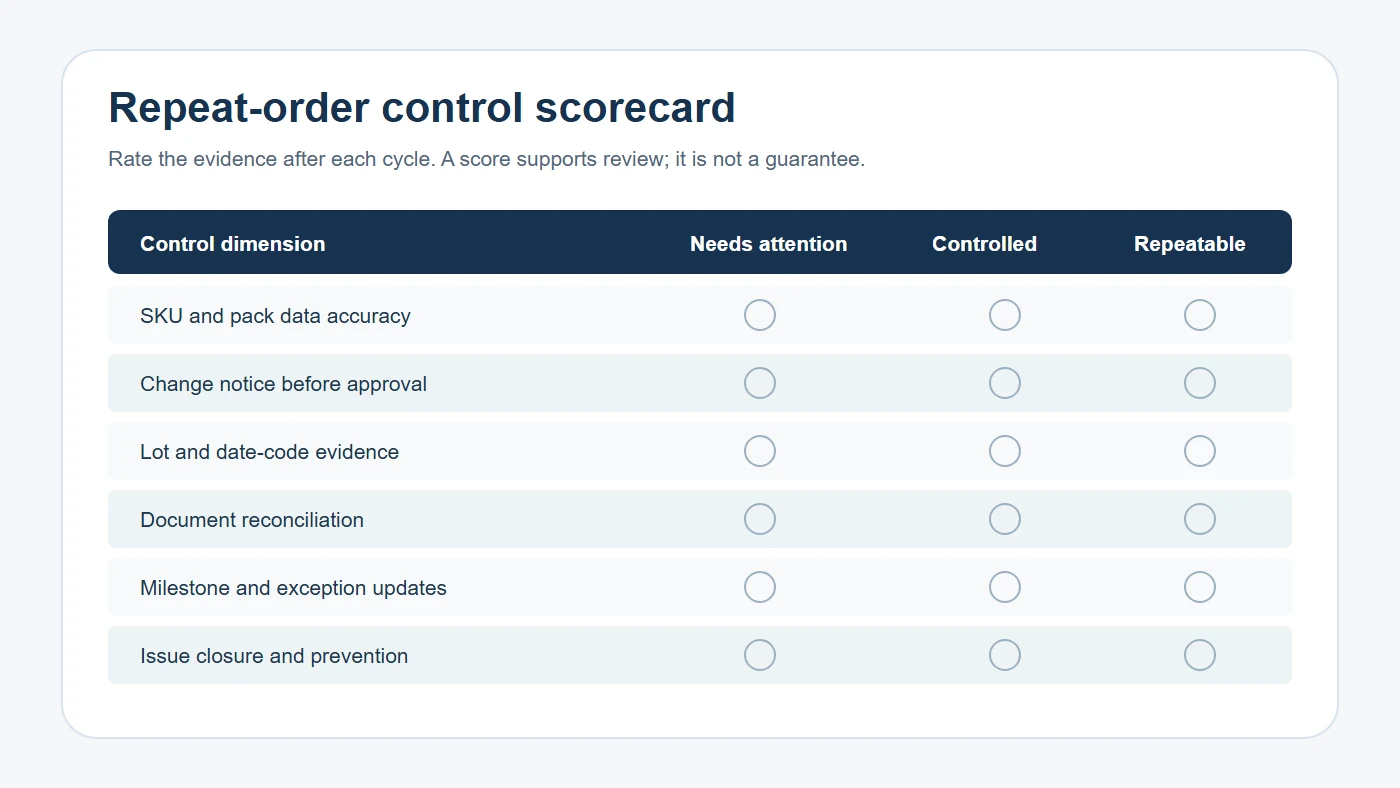
Update the scorecard after each cycle and link every rating to order-specific evidence.
| Control | What to review | Evidence note |
|---|---|---|
| SKU data accuracy | Names, pack versions, barcodes and case data match current evidence | Record mismatches and correction date |
| Change notice | Buyer receives material changes before approval or loading | Link notice and decision |
| Date-code control | Required lot/date condition is checked for the order | Reference the accepted evidence |
| Document accuracy | Draft and final documents match approved shipment data | Record revision or variance |
| Milestone reporting | Updates state impact, owner, deadline and next step | Note unresolved exceptions |
| Issue closure | Evidence, contractual outcome and prevention action are recorded | Check the next cycle |
Use the completed scorecard to shape the next purchase order. Controls that remain unclear should become explicit information requests or approval conditions. If the evidence is consistently weak, reduce operational assumptions and reconsider the order structure before increasing commitment.
Frequently Asked Questions
How many orders are needed to assess an FMCG exporter?
There is no universal number. One complete order provides an initial operating record, while several cycles under different conditions give stronger evidence of repeatability. Assess the process and documented outcomes rather than relying only on order count.
What should a repeat-order scorecard measure?
Measure controls that affect later orders: SKU and pack accuracy, change notice, date-code evidence, document reconciliation, milestone reporting and issue closure. Attach order-specific evidence to every rating.
How should product substitutions be managed?
The proposed replacement and its differences should be disclosed before approval. Record the buyer's written decision and update the commercial, packing and document records that depend on the changed item.
Why must shelf-life information be checked for every order?
Date codes and remaining shelf life can differ by SKU and lot. The buyer's required condition should be confirmed against evidence for the actual order rather than assumed from a previous shipment.
What should an exporter report when a milestone changes?
A useful update identifies the affected item or task, the operational or commercial impact, the responsible party, the decision deadline and the next update. Any timeline remains order-specific.
Planning a repeat order? Start with the OneDay FMCG overview, then send your repeat-order schedule, priority SKUs, destination, estimated quantities and control requirements through the contact page for an order-specific discussion.
Sourcing FMCG from Vietnam?
Tell us what you are looking for and we will come back with a wholesale offer.
RELATED ARTICLES
View All 14 Oct, 2026
Gum, Candy and Cookies: A Three-Format SKU Triage Checklist
 07 Oct, 2026
How to Source Vietnamese Coffee Wholesale: A Buyer Checklist
 25 Sep, 2026